
Chasing the Caldera: The Raw, Volcanic Heart of Santorini
Experience the sensory magic of Santorini, from the sun-drenched alleys of Oia to the jagged volcanic shores of Red Beach and the quiet trails of Fira.
The stone is hot beneath my sandals, baking under the relentless Aegean sun. The scent of wild thyme and roasting garlic drifts from a nearby taverna, mixing with the faint, salty breeze pulling up from the caldera below. I dodge a donkey carrying supplies and press myself against a blindingly white wall. The narrow alleys of Oia are a labyrinth of smooth plaster and blue domes, but right now, in the early afternoon, they are blessedly navigable.
"You are early for the show," the older man sweeping the stoop of a small ceramic shop says. It is more of an observation than a question.
"The sunset?" I ask, wiping a bead of sweat from my forehead.
He laughs, a deep, resonant sound that seems to echo off the whitewashed walls. "Yes. The crowds will come like a tide at six. You are smart to come for lunch. Eat, walk, claim your space now. Later, you won't even be able to park a car."
I nod, thanking him, and realize how right he is. Most travelers make the mistake of rushing to the northern tip of the island just as the sun begins to dip, finding themselves shoulder-to-shoulder in a frantic scramble for the perfect photograph. Arriving at midday shifts the entire rhythm of the experience. You have time to let the village reveal itself slowly, to browse the small boutiques without being jostled, and to secure a table with a view long before the golden hour begins.
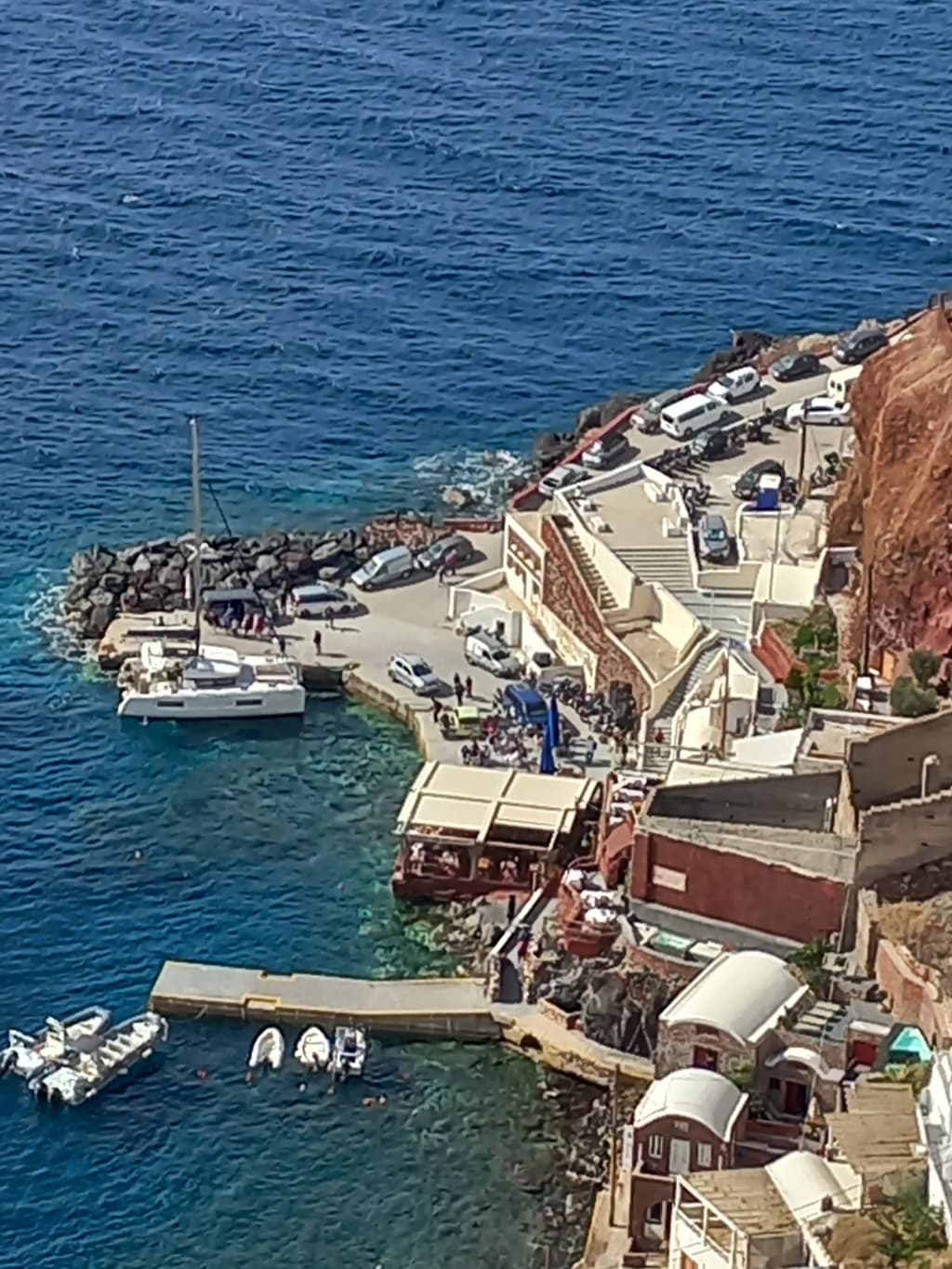
To understand Santorini, you have to understand its shape. The island is a massive, jagged crescent—a 'C' carved out by an ancient volcanic eruption. The inner curve is the caldera edge, towering violently above the sea, while the outer edge slopes more gently toward the water.
It takes about fifty minutes to drive from one end of the crescent to the other. Fira sits right in the bustling middle, acting as the island's beating heart, while Oia crowns the northern tip. But it is the spaces in between that hold a quieter magic. I think of the smaller villages I passed through earlier—the sleepy, romantic charm of Imerovigli, the medieval, labyrinthine alleys of Pyrgos, and the wind-swept quiet of Emporio. They offer a reprieve from the dense crowds of the main hubs, a place to simply exist alongside the locals rather than spectate.
The path connecting Fira and Oia is a ribbon of dust and stone suspended between the sky and the sea. I take it slow. The crunch of volcanic gravel underfoot is a constant rhythm. It isn't a highly technical climb, but the uneven steps and the undulating hills demand your attention.
Every time I stop to catch my breath, the view demands it be stolen again. The caldera drops away to my left, a sheer cliff plunging into water so blue it looks thick, almost like wet paint. Far below, I can faintly make out the dark stretches of Kamari and Perissa beaches. The hike takes a few hours, but time up here feels entirely unmoored from the clocks in the villages below.
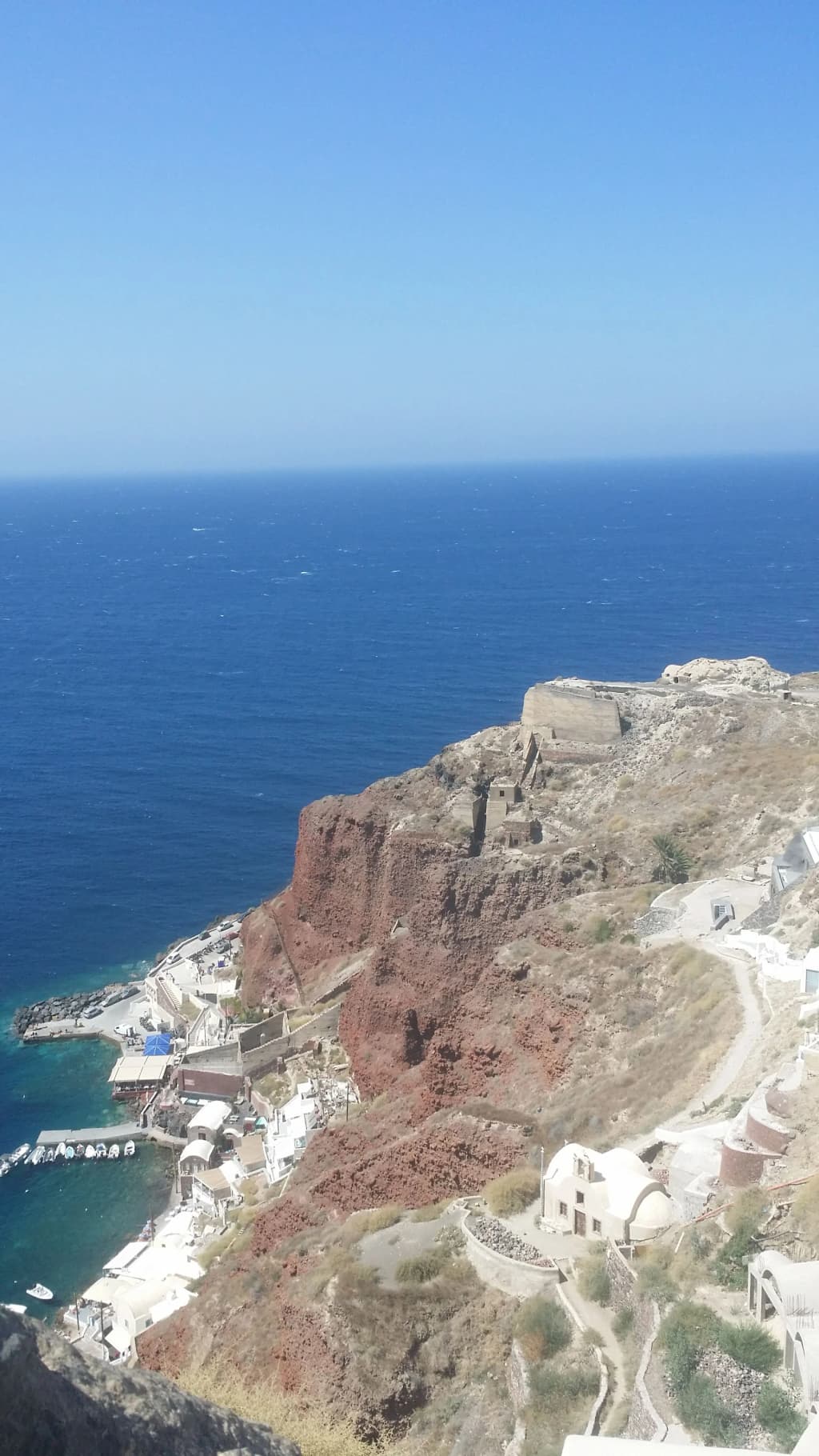
When I finally make it down to the water the next morning, the reality of Santorini's volcanic birth becomes tactile. If you come to this island looking for the powdery white sands of the Caribbean, you will be deeply confused. The earth here doesn't yield; it is forged in fire.
The beaches are dark, dramatic stretches of coarse black sand and smooth pebbles that absorb the midday heat until they are nearly too hot to walk on. I am intensely grateful for the cheap, five-euro rubber water shoes I picked up at a sporting goods store before the trip. They look ridiculous, but as I wade into the water, stepping over submerged, jagged volcanic rocks, they feel like the best investment I've ever made.
I pull a pair of goggles over my eyes and dive. The water of the Aegean is startlingly cold at first, then incredibly refreshing. Because there is no fine sand to churn up in the surf, the visibility is absolute. Schools of silver fish dart around the dark underwater boulders. It is a quiet, weightless world down here, a stark contrast to the busy cliff-tops above.
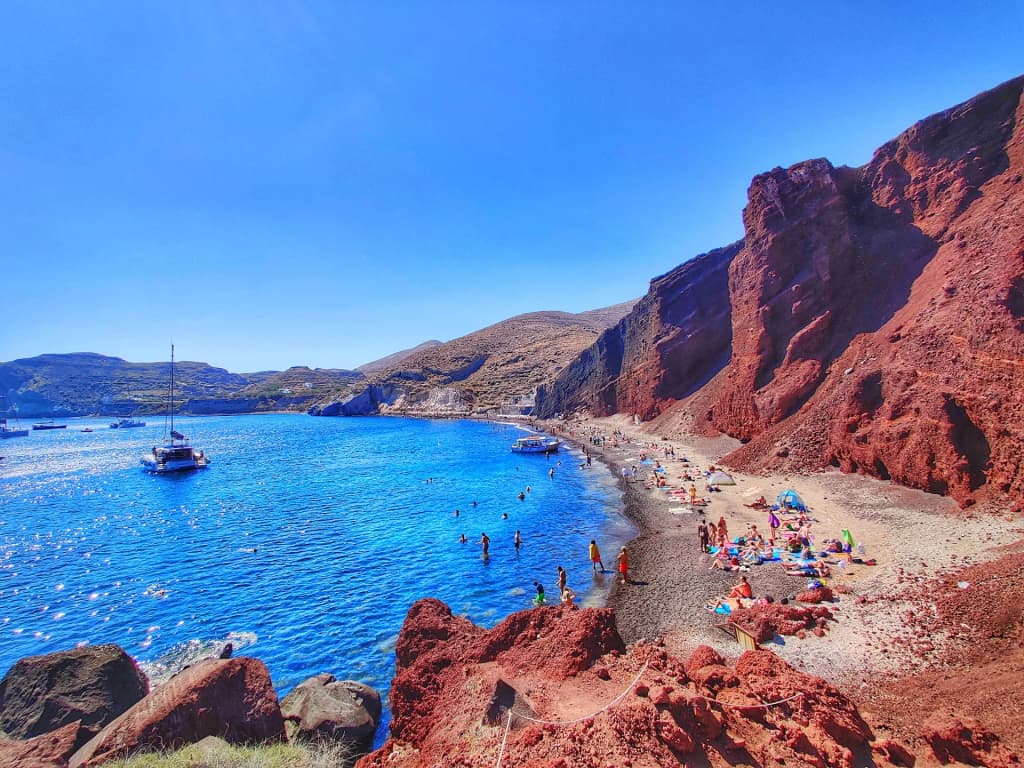
Nowhere is the island's violent geology more apparent than at Red Beach. The towering crimson cliffs look like they belong on Mars, crumbling down to meet the dark, sapphire water. But the beach itself is narrow and rocky, making it nearly impossible to comfortably lay down a towel.
Instead of fighting for a patch of uncomfortable gravel, I opt for the water. The ninety euros for an afternoon catamaran tour felt steep when I booked it online, but as the sails catch the wind and we pull away from the shore, the price fades from memory.
We drop anchor just off the coast of the red cliffs. Seeing the island from the outside looking in—staring up at the towering walls of stone rather than peering down from them—shifts my entire perspective. We sail past quieter coves that are inaccessible by foot, the boat rocking gently as the crew grills fresh seafood right on the deck.
Evening falls, and I am back on the caldera edge, this time in Fira. The smell of grilled octopus and lemon hangs heavy in the cooling air. The tavernas clinging to the cliffside are filling up, the clinking of wine glasses harmonizing with the low hum of multiple languages.
Dining on the edge of the caldera is a calculated luxury. You pay for the view, and the view is undeniably spectacular. But I've learned that if you wander just a few streets inland, away from the precipice, the prices drop significantly while the quality of the moussaka and fava dip only rises. Tonight, though, I allow myself the indulgence of the edge. I secured my reservation days ago, knowing that walking into a caldera-view restaurant at sunset without one is an exercise in futility.
The sun finally meets the horizon, turning the white buildings around me a soft, glowing peach, then a deep violet. The island's lights begin to flicker on, one by one, cascading down the dark cliffs like fallen stars. The wind picks up, carrying the chill of the sea. I take a sip of crisp Assyrtiko wine, feeling the cool glass against my warm palm. The crowds are still here, the narrow alleys are still packed, but in this moment, looking out over the submerged volcano, the island feels entirely still.
More Photos
More Adventures
 $150 - $350/day 3-4 days
 Trancoso Travel Guide: 3-Day Itinerary & Budget Breakdown
Plan a practical 3-day trip to Trancoso, Brazil. Discover the best beaches, UTV tours to Praia do Espelho, and exact costs to optimize your travel budget.
 $100 - $350/day 5-7 days
 Ditch Your Shoes: The Ultimate Jericoacoara Adventure Guide
Skip the tourist traps. Rent an ATV, dive into Buraco Azul, and taste the wild side of Jericoacoara. Your ultimate adventure guide to Brazil's sandy paradise.
 $50 - $150/day 5-10 days
 Conquer Ceará: The Ultimate Route of Emotions Road Trip
Ditch the resorts and hit the dunes. Discover the wild side of Ceará, Brazil, from hidden lagoons in Camocim to the electric nightlife of Jericoacoara.
 $30 - $60/day 3-5 days
 Skip the Beach: The Mystical Quartz Mountain of São Thomé
Trade the beach for the mountains. Explore São Thomé das Letras, Brazil's off-grid quartz town. Dive into waterfalls, dark caves, and defy gravity.