
Stone, Soil, and Salt: A Sensory Loop Through Tuscany
A narrative journey through Tuscany's art cities, rolling vineyards, and wild coastlines, discovering the region's true rhythm beyond the guidebooks.
The smell hits you first. It is charcoal smoke, roasted garlic, and the sharp, tannic scent of leather baking in the sun. It radiates from the pavement and hangs heavy between the stone walls. I am standing on a corner in Florence, dodging a bicycle that rattles over the cobblestones, and the city feels less like a museum and more like a living, breathing creature.
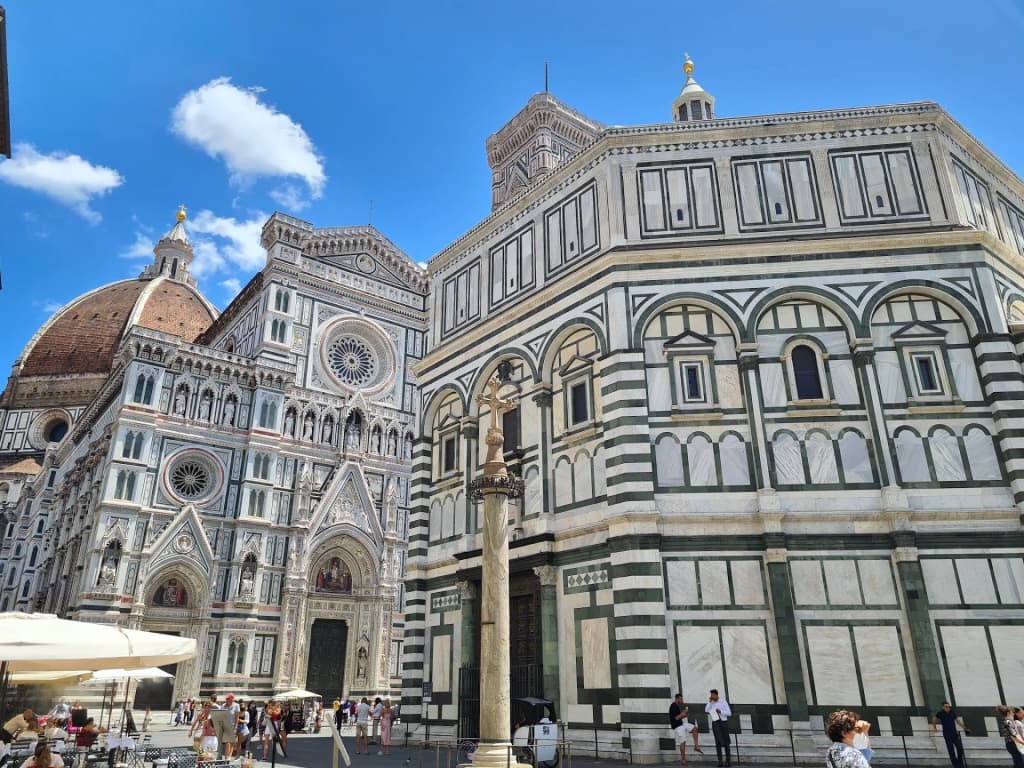
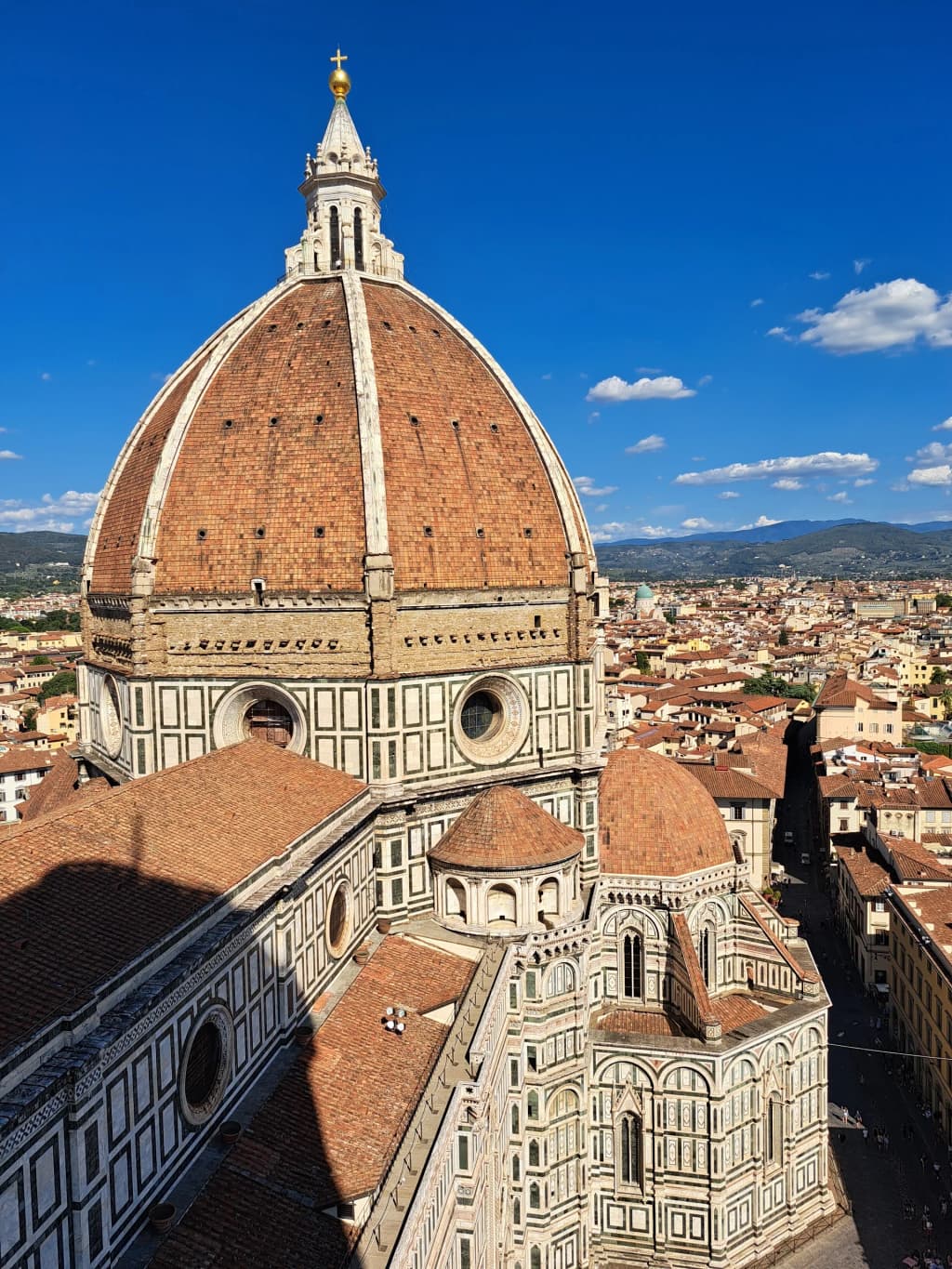
The Cathedral of Santa Maria del Fiore dominates the skyline, but not in the polite way postcards suggest. It imposes itself. The terracotta dome is an impossible shade of burnt orange against the hard blue sky, anchoring the chaos of the streets below. I stand there for a long time, neck craned back, tracing the white and green marble patterns that look more like embroidery than masonry. The line to climb the dome wraps around the building—a two-hour wait, I overhear—so I choose the ground instead. The real energy is here, in the shadow of the giant.
I duck into a small trattoria away from the main thoroughfare, seeking refuge from the midday heat. The waiter, a man with lines etched deep into his face and a white apron tied tight, nods when I ask for the bistecca alla fiorentina.
"You are alone?" he asks, glancing at the empty chair. "Just me," I say. He smiles, a quick flash of gold tooth. "Better. You don't have to share the meat."
He brings a carafe of house red that costs less than the water in the tourist traps. It tastes rough and honest. Florence demands this kind of appetite. Whether it's the rich vegetable stew of ribollita or the tripe sandwiches sold from carts, you have to eat to understand this place. I spend the afternoon walking it off, losing myself in the corridors of the Uffizi. I booked my ticket online weeks ago to skip the line, a small victory that feels significant as I breeze past the sweating crowds. By evening, the Arno river is a sheet of dark glass, reflecting the lights of a city that hasn't changed its shape in centuries.
If Florence is the confident Renaissance prince, Siena is the brooding medieval knight. The drive south changes the palette from gold to burnt sienna—literally. The brickwork here feels older, more defensive. I leave my rental car outside the city walls—parking inside is a nightmare of fines and narrow lanes—and walk up into the shell-shaped embrace of the Piazza del Campo.
People sit directly on the warm bricks, leaning back, watching the sky shift from blue to violet. This is the stage for the Palio, the frantic horse race that turns the city into a tribal war zone twice a summer, but today it is quiet. I wander up to the Cathedral, where the floor panels tell stories in marble graffiti. Siena feels intimate, a place of secrets hidden down winding alleys that seem to turn back on themselves.
To understand Tuscany, though, you have to leave the stone behind and get your hands into the soil. I steer the car toward the Val d'Orcia, where the landscape shifts into that dreamlike quality you see in paintings: rolling green waves, solitary farmhouses perched on crests, and lines of cypress trees standing like soldiers at attention.
In Montalcino, the air smells of fermentation and damp earth. This is the home of Brunello, a wine that demands patience. I stop at a vineyard just outside the town walls. The owner, Elena, pours a glass of the dark red liquid. It tastes of cherries and wood smoke.
"The Sangiovese grape is difficult," Elena tells me, swirling her glass. "It is stubborn. Like us." "Is that the secret?" I ask. She laughs, a warm, throaty sound. "The secret is the clay and the limestone. The vine has to struggle to find water. The struggle makes the fruit sweet. There is no good wine without a little suffering."
I carry that thought with me as I drive through the Chianti region. The "Wine Road" winds past castles and ancient abbeys. Every curve reveals a new vista of olive groves and vines, evidence of centuries of agriculture that looks more like gardening on a massive scale.
The verticality of Tuscany returns when I reach San Gimignano. From miles away, the towers scratch the sky, a medieval Manhattan rising from the fields. It is crowded, yes, but the Vernaccia white wine—crisp and floral—makes the shoulder-to-shoulder walking bearable. I grab a cone of gelato from the central piazza and climb toward the Torre Grossa. The view from the top stretches all the way to the Apennines, a sea of green haze.
Not far away, Lucca offers a different kind of geometry. Encased in massive Renaissance walls, the city is a circle of calm. I rent a bicycle for a few euros and ride along the top of the ramparts, a wide, tree-lined boulevard that loops the entire town. Looking down, I see the Piazza dell'Anfiteatro, built on the ruins of a Roman arena, where the houses curve in a perfect oval. It feels protected here, a world within a world.
Even Pisa, with its famous leaning mistake, has a charm beyond the selfie-snapping crowds. Once you leave the miracle of the tower and the baptistery, the streets along the river offer a quiet dignity that feels miles away from the souvenir stalls.
Eventually, the hills give way to the scent of salt. The Maremma is the wild west of Tuscany, a place of cowboys, wild boars, and rugged scrubland. The food changes here, too. The delicate pastas are replaced by hearty boar stews and fresh fish grilled over wood fires.
I drive to Piombino and take the ferry to Elba Island, watching the mainland fade into the mist. The water is a startling turquoise. This isn't just a place of exile for Napoleon; it’s a hiker's paradise. I spend a morning climbing Monte Capanne, the highest peak, breathing in air that smells of pine and sea spray. Later, on the beach at Fetovaia, I float in the Tyrrhenian Sea, washing off the dust of the medieval towns.
The sun sets on my final day, turning the vineyards a deep, bruising purple. I realize I haven't just seen a region; I've felt it. The rough stone of Siena, the dry soil of the Val d'Orcia, the cool marble of Florence, and the warm hospitality of the coast. Tuscany is not a checklist to be completed. It is a rhythm to be joined. It stays with you, caught in the back of your throat like a good red wine, long after the suitcase is unpacked.
More Photos
More Adventures
 $40 - $80/day 3-5 days
 Into the Wild: Surviving Roraima's Macuxi Territory
Skip the tourist traps. Plunge into the raw culture of the Macuxi tribe in Roraima, Brazil. Experience fire-hot stews, sacred rituals, and wild borders.
 $150 - $350/day 3-4 days
 Trancoso Travel Guide: 3-Day Itinerary & Budget Breakdown
Plan a practical 3-day trip to Trancoso, Brazil. Discover the best beaches, UTV tours to Praia do Espelho, and exact costs to optimize your travel budget.
 $100 - $350/day 5-7 days
 Ditch Your Shoes: The Ultimate Jericoacoara Adventure Guide
Skip the tourist traps. Rent an ATV, dive into Buraco Azul, and taste the wild side of Jericoacoara. Your ultimate adventure guide to Brazil's sandy paradise.
 $30 - $60/day 3-5 days
 Skip the Beach: The Mystical Quartz Mountain of São Thomé
Trade the beach for the mountains. Explore São Thomé das Letras, Brazil's off-grid quartz town. Dive into waterfalls, dark caves, and defy gravity.