
The Earth Breathes in Minas Gerais: Getting Lost in Inhotim
Deep in the Brazilian Atlantic Forest, Instituto Inhotim blurs the line between contemporary art and wild nature. A sensory journey through a jungle museum.
The vibration hits the soles of my boots before the sound ever reaches my ears. A low, guttural hum, like the slow, rhythmic breathing of a sleeping giant, echoes from deep within the bedrock. I am standing inside a glass structure that looks vaguely like a flying saucer, perched high on a hill in the Brazilian state of Minas Gerais. In the center of the room, a massive hole plunges two hundred and two meters directly into the earth. Doug Aitken's Sonic Pavilion doesn't just display art; it forces you to listen to the planet. Highly sensitive microphones capture the tectonic shifts, the subterranean murmurs, the quiet groans of the dirt, and broadcast them in real time. The sound is heavy, ancient, and deeply comforting.
"You'll want the cart," the woman at the ticket counter tells me earlier that morning, sliding my paper pass across the glass.
I look at the map she hands me, a sprawling, intimidating web of green intersecting lines. "I like to walk," I tell her.
She laughs, a warm, knowing sound that echoes slightly in the concrete pavilion. "Everyone likes to walk until the midday sun hits the Atlantic Forest. It's one hundred and forty hectares. We have over four thousand plant species out there. It's fifty reais for entry today, but add the thirty-five for the transport. Trust me."
I trust her, and it becomes the best decision I make all day. Instituto Inhotim is not a museum in any traditional sense. It is a sprawling kingdom of contemporary art swallowed by a botanical garden, located about forty kilometers from the bustling capital of Belo Horizonte, in the quiet mining town of Brumadinho. The electric carts operate like a jungle transit system, picking you up at designated stops and silently whisking you through tunnels of giant palm leaves and sprawling, century-old chestnut trees to the next gallery.
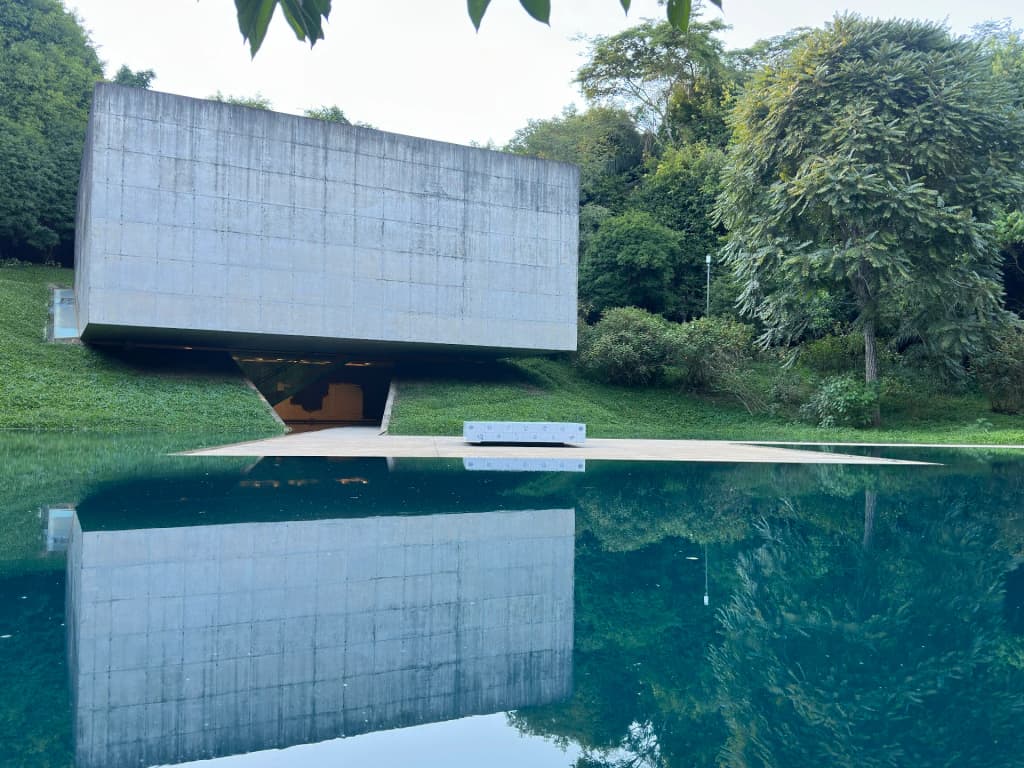
The air here is thick, carrying the smell of damp earth, blooming orchids, and distant rain. I hop off the cart near a structure that stops me in my tracks. The Adriana Varejão Gallery sits like a massive, brutalist concrete block hovering impossibly over a placid water mirror. The reflection is so perfect it creates a dizzying illusion of endless space. Inside, the art is visceral. I stand before Linda do Rosário, a piece where the pristine, colonial-style blue tiles seem to have been violently torn apart to reveal fleshy, blood-red innards beneath. It is a shocking, gorgeous commentary on history and bodies, made all the more powerful by the absolute silence of the concrete room.
By early afternoon, the heat of the Brazilian sun presses down heavily. I find refuge at Casa dos Sucos, a small wooden outpost tucked beneath a canopy of broad-leafed trees. The icy, deep-purple sweetness of a fresh bowl of açaí cuts through the humidity, paired perfectly with the flaky, buttery crust of a warm empadinha. I sit on a bench crafted from a massive slab of reclaimed wood—the work of designer Hugo França, whose organic seating is scattered throughout the park like fallen timber—and watch the wind ripple across the surface of a nearby lake.
Just across the grass lies Yayoi Kusama's Narcissus Garden. Seven hundred and fifty stainless steel spheres float on the water's surface. As the breeze picks up, the metal balls clink together with a hollow, melodic chime, shifting formations entirely. The art here is never static. It breathes with the weather.
Further down the path, the landscape turns rugged. A jagged crown of rusted steel beams violently pierces the sky. This is Chris Burden's Beam Drop. In the eighties, he dropped massive steel girders from a crane into a pit of wet concrete. The violence of gravity and chance dictated the final sculpture. Standing beneath it, the smell of oxidized iron mixing with the sweet scent of tropical flowers, you can almost feel the phantom impact shaking the ground.
If Inhotim is about pushing boundaries, the Cildo Meireles Gallery shatters them entirely. I walk into Desvio para o Vermelho (Red Shift) and my eyes struggle to adjust. Every single object in the furnished room—the rug, the sofa, the typewriter, the paintings, the lamps—is a vivid, suffocating shade of red. It feels like stepping inside a vein.
But it is his installation Através (Through) that stays with me. The docent gestures for me to step forward. My boots meet the floor, and the sharp, violent crunch of broken glass shatters the quiet of the gallery. You literally walk over a sea of shattered glass, navigating a labyrinth of barriers—prison bars, mosquito nets, chain-link fences. With every step, the grinding of glass beneath my feet sends a shiver up my spine. It is art that makes you hyper-aware of your own physical presence, your own weight, your own fragility.
The shadows begin to lengthen, painting the Atlantic Forest in deep strokes of gold and bruised purple. A crucial piece of advice the woman at the ticket counter neglected to mention: the transport carts stop running at four o'clock sharp, even though the park doesn't close until four-thirty.
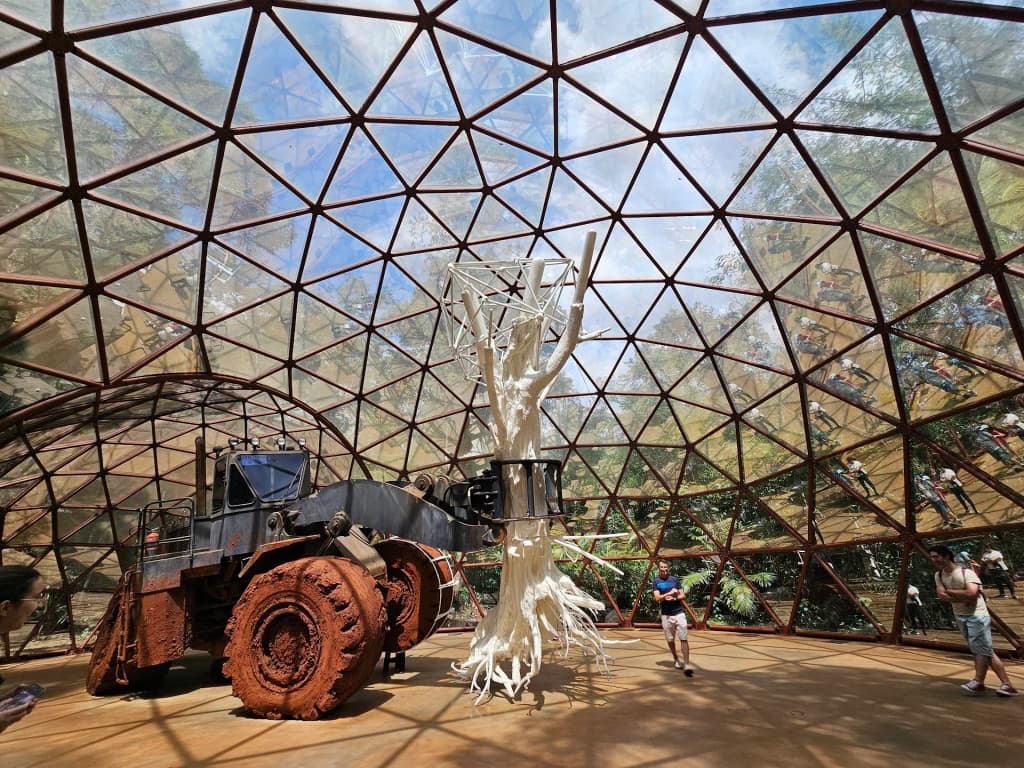
I find myself deep in the park, facing a long walk back. But the forced march is a blessing. The manicured paths give way to the wilder edges of the botanical garden. I pass Matthew Barney's geodesic dome, looking like a crashed spaceship in the jungle, housing a massive tractor wrestling with an uprooted tree. I wander through the Claudia Andujar gallery, where over four hundred haunting, beautiful photographs document the lives of the Yanomami people from the deepest Amazon, their eyes staring out from the 1950s into the present moment.
By the time I reach the exit, my legs ache and my shirt clings to my back with sweat. I had thought one day would be enough to see it all. It isn't. Not even close. You don't just view the art at Inhotim; you hike through it, you sweat with it, you listen to it hum from the center of the earth. As I walk out through the heavy wooden gates, the sound of the jungle rising into its evening chorus, I realize the true masterpiece isn't any single gallery. It is the wild, audacious idea that art and nature do not have to be separated by white walls, but can grow wildly, untamed, together.
More Photos
More Adventures
 $50 - $150/day 1-2 days
 Conquer the Serra Verde Express: Brazil's Wildest Train
Ditch the tourist traps and ride the Serra Verde Express from Curitiba to Morretes. Discover ticket tips, seating secrets, and the best Barreado.
 $150 - $300/day 1-2 days
 Conquer Epcot: The Ultimate High-Speed Global Gauntlet
Think Epcot is a slow stroll? Think again. It's a high-speed, globe-trotting gauntlet. Hack the rides, taste the world, and push your limits in Orlando.
 $50 - $120/day 2-3 days
 Earth, Fire, and Lavender: A Sensory Weekend in Cunha
Breathe in the lavender fields, taste alpine mountain beer, and feel the heat of traditional Japanese kilns in the mountain village of Cunha, São Paulo.
 $50 - $120/day 3-5 days
 Chasing Echoes and Gold Dust in Tiradentes, Brazil
Experience Tiradentes, Brazil through a sensory journey of colonial architecture, deep-rooted history, and the rich culinary traditions of Minas Gerais.