
Behind Padded Doors: The Midnight Magic of Japanese Karaoke
Step inside the neon-lit world of Japanese karaoke culture. Discover how private rooms offer a late-night sanctuary of song, food, and sensory escape.
The bass thumps faintly against the soles of my shoes, a rhythmic heartbeat vibrating through the carpeted hallway. It smells of ozone, citrus floor cleaner, and a faint, lingering note of fried chicken. Everywhere you look, narrow doors line the corridor, each one a portal to a different universe. Behind one door, a group of businessmen in loosened ties are belting out a nostalgic nineties rock anthem. Behind another, a solitary voice croons a melancholy pop ballad.
I step up to the front counter, wiping the damp Tokyo drizzle from my jacket. The lobby is a wash of fluorescent light, a stark contrast to the moody, neon-soaked streets outside. The city is a cacophony of sirens, crosswalk melodies, and millions of footsteps, but in here, the chaos is compartmentalized into perfect, soundproofed cubes.
"First time here?" the attendant asks, his voice competing with a sudden, joyous burst of laughter from a nearby suite as a heavy door briefly swings open.
"In this neighborhood, yes," I say, handing over my dripping umbrella.
He nods, his smile polite and practiced, and taps a laminated menu on the counter. "Room 402. One hour and a half. Enjoy your private stage."
He hands me a small clipboard with our time stamped on it. The slip of paper says it will cost us about two thousand yen—roughly thirteen dollars—for ninety minutes of sanctuary. That covers the rental of the room itself and the mandatory drink order we place before walking away. It feels like a ridiculously small price to pay to own a tiny slice of Tokyo real estate, even if just for the evening.
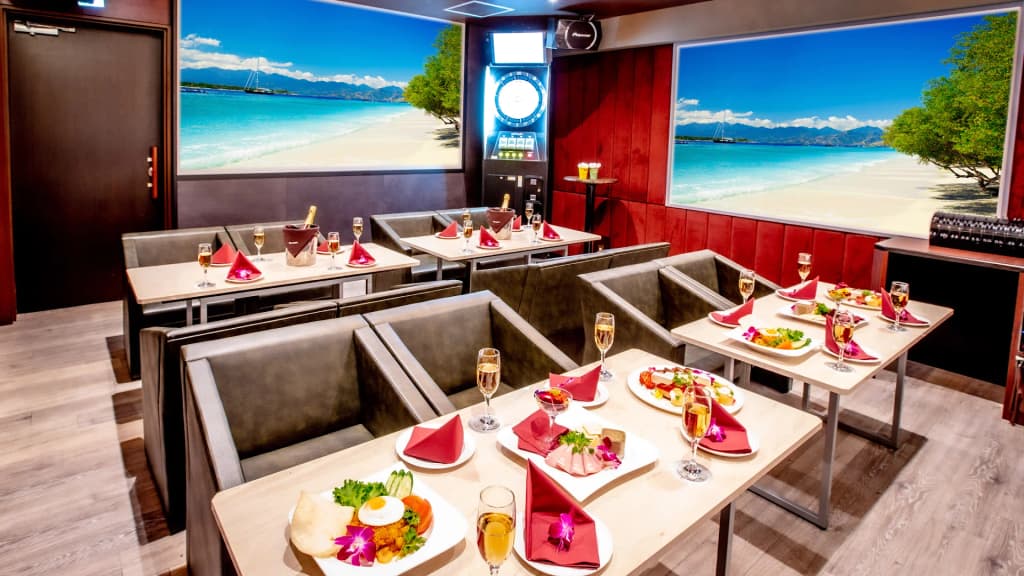
We push open the heavy, padded door to Room 402. The immediate silence is almost jarring. The thick walls swallow the hallway noise entirely, leaving us in a cozy, dimly lit box dominated by a massive television screen and a low, wraparound leather sofa that sighs as I sink into it, the material cool against my damp jeans.
The air conditioning hums a quiet, icy tune. I run my hand along the sticky plastic of the tambourine resting on the table—a silent invitation to participate even if you aren't holding the microphone.
This is the magic of the Japanese karaoke box. Back home, karaoke is often a public spectacle, an act of liquid courage performed in a crowded dive bar for an audience of judgmental strangers. Here, it is an intimate affair. It is a release valve for a society that demands public harmony and quiet restraint. You come here after work, after school, or after a long day of temples and train stations, to scream, sing, and shed your skin behind a closed door.
The glowing tablet on the table is our digital conductor. It is slick, bright, and heavy in my hands. I tap the screen, watching the interface shift seamlessly into English.
The sheer volume of choices is staggering. It is not just Japanese pop or classic rock; there are thousands of international tracks. We find ourselves scrolling through Brazilian Portuguese hits, underground indie anthems, and Broadway show tunes.
But the tablet is more than just a songbook. A dedicated button brings up an extensive menu of food and drinks. Without ever speaking to another human being or leaving the comfort of our leather booth, we tap our way to a plate of piping hot karaage—Japanese fried chicken—and two tall, condensation-beaded glasses of melon soda.
Fifteen minutes later, a soft knock precedes a server sliding into the room, dropping off our feast with a quick bow before vanishing back into the labyrinth of hallways. The chicken is dangerously hot, tasting of soy, ginger, and perfectly rendered fat, washing down beautifully with the sharp, sweet fizz of the neon-green soda.
Time loses its meaning in the karaoke box. There are no windows here, no shifting shadows to tell you that the sun has set or that midnight has come and gone.
I grip the metallic microphone, the cool steel grounding me as the lyrics to an old favorite turn from white to electric blue across the screen. We sing until our throats are scratchy, passing the mic back and forth, shaking the plastic tambourine until our wrists ache. The music swells, filling the tiny space so completely that you can feel the bass in your chest. It is entirely judgment-free. You can miss every note, completely butcher the melody, and the only consequence is a digital score at the end of the song that flashes on the screen with polite, animated confetti.
Many of these establishments operate twenty-four hours a day, making them the ultimate refuge. When you have spent the entire day walking miles through Shibuya or navigating the dense crowds of Asakusa, your feet aching and your senses overloaded, the karaoke room offers a rare pause. You do not even have to sing if you do not want to. I have known travelers who rent a room just to rest their feet in an air-conditioned space, sipping iced tea while watching music videos play on loop.
The phone on the wall rings with a harsh, trilling sound. It is the front desk, offering a polite ten-minute warning. Our ninety minutes have evaporated.
We gather our coats, suddenly hyper-aware of the silence in the room now that the music has been paused. My throat feels a little raw, my ears ringing with a pleasant, muffled hum.
The transition is always abrupt. One moment you are a rock star in a private universe, the next you are just another pedestrian. Stepping back out onto the street, the Tokyo air feels cooler, cleaner. The rain has stopped, leaving the pavement slick and reflective, mirroring the neon signs that stretch endlessly into the night sky. The city is still moving, still humming with its own quiet rhythm. But for an hour and a half, we did not have to march to its beat. We had our own room, our own rules, and our own soundtrack, hidden away behind a padded door in the sky.
More Photos
More Adventures
 $150 - $300/day 1-2 days
 Conquer Epcot: The Ultimate High-Speed Global Gauntlet
Think Epcot is a slow stroll? Think again. It's a high-speed, globe-trotting gauntlet. Hack the rides, taste the world, and push your limits in Orlando.
 $40 - $120/day 14-30 days
 The Taste of Chili and Time Travel: Everyday Magic in Thailand
Immerse yourself in the sensory details of Thailand's deeply rooted culture, from Buddhist calendars and saffron-robed monks to street food rules.
 $50 - $150/day 5-10 days
 Finding the Rhythm of Bahia: From Porto Seguro to Trancoso
Experience the sensory magic of Brazil's Costa do Descobrimento, from the chaotic nightlife of Porto Seguro to the barefoot luxury of Trancoso's beaches.
 $200 - $500/day 2-3 days
 Conquer Disneyland California: The Ultimate 2-Park Guide
Think Disneyland is just a walk in the park? Think again. Get the ultimate battle plan for dominating Disneyland and California Adventure. Skip the lines.