
Palmas: Heat, Concrete, and the River Soul of Tocantins
Beyond the gateway to Jalapão, Palmas reveals itself as a city of intense solar beauty, vast squares, and river islands. A guide to Brazil's youngest capital.
The light reflects off the white marble of the Araguaia Palace with such intensity that I have to squint just to check my watch. It is noon in the Praça dos Girassóis, and the heat is not merely a temperature; it is a physical weight, pressing down on the vast, geometric expanse of concrete. There is no humidity here, only a dry, piercing solar presence that seems to bake the silence into the air.
An older man pushes a cart selling popsicles, his movement slow and deliberate. He stops near me, wiping his forehead with a fraying cloth.
"You are walking?" he asks, looking at my camera.
"Just for a bit," I say.
He chuckles, a dry sound like crushing leaves. "One sun for each person. That is what we say here in Tocantins. You have your own sun today, my friend."
I buy a lemon popsicle just to feel something cold. This is Palmas. Most travelers treat this city as a mere logistical pause—a place to land, sleep for six hours, and jump into a 4x4 heading east toward the dunes of Jalapão. But standing here, in the center of the largest public square in Latin America, I sense a strange, stark ambition. The scale is overwhelming, designed for giants rather than pedestrians, but there is a raw beauty in its audacity.
To understand this landscape, you have to understand that none of this existed forty years ago. Tocantins is the youngest child of the Brazilian federation, sliced away from the state of Goiás in 1988 because the north felt forgotten. They drew a line on a map and decided to build a future from the red dust of the cerrado.
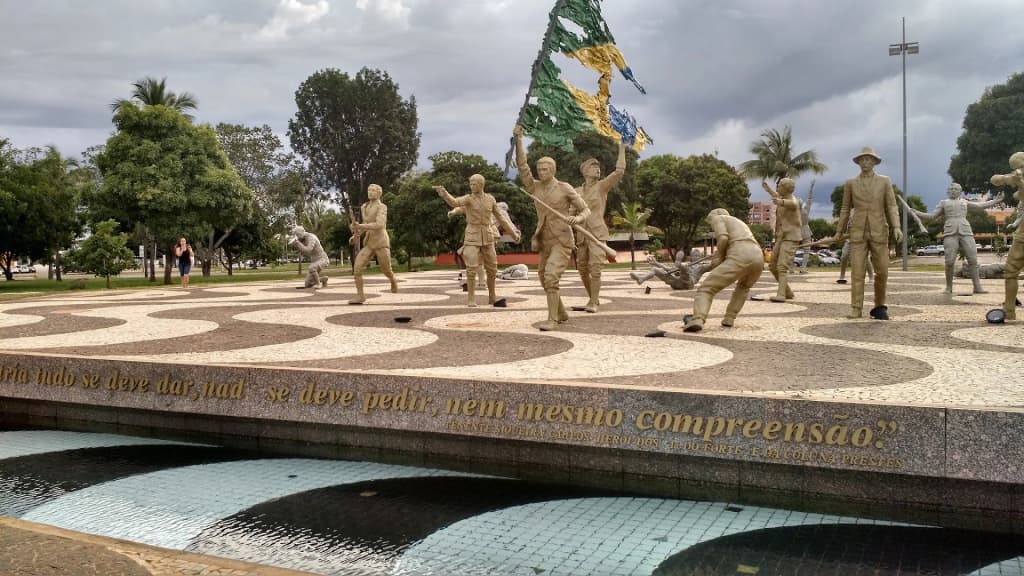
Walking past the Monument to the 18 of the Copacabana Fort—a bronze sculpture that feels surreal against the flat horizon—I feel like I am walking through a blueprint that has suddenly sprung to life. The avenues are wide enough to land airplanes. The rotundas are massive. The city was born on January 1st, 1990, and it still feels like it is growing into its own skin. It is a place of planners and engineers, imposing order on the wild scrubland.
The sun eventually wins the argument, and I retreat to Parque Cesamar. It acts as the city's lungs, a dense patch of green that offers the only real sanctuary from the midday glare. The temperature drops the moment I step under the canopy. The smell of baking asphalt is replaced by the scent of damp earth and decomposing leaves.
I sit on a bench near the lake, watching families spread out picnic blankets. A movement in the grass catches my eye. An iguana, green and prehistoric, freezes mid-step. A few meters away, a family of capybaras grazes near the water's edge, entirely indifferent to the joggers passing by. In a city defined by concrete and geometry, this chaotic burst of life feels essential. It is a place to slow down, to drink coconut water, and to wait for the heat to break.
By late afternoon, the Tocantins River pulls us toward its banks. It is so wide here it mimics the ocean, stretching out to the horizon. At Graciosa Beach, the pier is busy with locals looking for relief. I hand fifty reais to a boatman for a round trip to Ilha do Canela.
"The wind is good today," he shouts over the roar of the engine. The boat cuts through the brown water, offering a breeze that feels like a benediction.
Ilha do Canela is an artificial island, a resort oasis anchored in the river flow. Kiosks with thatched roofs serve cold beer and fried river fish. I order a platter for two—it comes to nearly 130 reais, a price that reflects the logistics of island dining more than the ingredients—but the setting justifies the cost.
The most striking feature, however, is the swimming area. A thick mesh net creates a perimeter in the water.
"Is the current that strong?" I ask the waiter as he sets down our lime-crusted fish.
"It's not the current," he says, pointing to the open water beyond the net. "It's the piranhas. They own the river. We just borrow this little piece."
I swim inside the net, the water tepid and silty. Knowing what swims just meters away adds a thrill to the dip. Across the water, the skyline of Palmas shimmers in the heat haze, a mirage of vertical lines against the flat sky.
We return to the mainland expecting a golden sunset, but the cerrado is unpredictable. It is September, the height of the dry season, yet dark, bruised clouds begin to swallow the sky. The air pressure drops. Suddenly, the rain comes—not a drizzle, but a violent, cleansing downpour that hasn't been seen here since May.
From my room at the Hplus Premium, I watch the storm transform the city. The view usually stretches to the river, but now it is a wall of grey water. The smell of petrichor—rain hitting dry earth—drifts even through the air conditioning.
When the rain stops, the city glitters. The dust is washed away, and the red earth turns a deep crimson. Palmas is often dismissed as a waypoint, a hot and dusty interval before the real adventure begins. But as I watch the streetlights reflect off the wet pavement, I see a city with its own gravity. It is a frontier town dressed in the clothes of a capital, fighting the sun every day, and carving out a life in the heat.
More Photos
More Adventures
 $50 - $150/day 1-2 days
 Finding Holland in the Tropics: Two Days in Holambra
Discover Holambra, Brazil's unexpected Dutch enclave. Wander through luminous flower fields, towering windmills, and rich European history in São Paulo state.
 $40 - $80/day 4-6 days
 Forget the Beaches: Why Curitiba is Brazil's Ultimate Adventure
Skip the crowded tourist traps. Discover Curitiba, Brazil's green capital, featuring gravity-defying architecture, epic train rides, and budget thrills.
 $100 - $300/day 1-3 days
 Escape the Airport: Conquer Your Luanda Layover
Think a layover in Luanda means killing time at the airport? Think again. Discover the fortress, island sunsets, and the ultimate Angolan adventure.
 $100 - $250/day 3-7 days
 Beyond the Turnstiles: An Orlando Summer Sabbatical
Escape the Orlando theme park crowds and discover the sensory magic of Celebration, the Mall at Millenia, and the neon-soaked shores of Universal CityWalk.