
Beyond Praia do Félix: Ubatuba's Secret Shell Coast
Join a sensory journey across Praia do Félix in Ubatuba, scrambling over rocks to Praia do Português and trekking the jungle to a shell-covered cove.
The sizzle of hot oil overpowers the gentle lapping of the morning tide. I am standing beneath the sprawling canopy of an ancient almond tree at the far right corner of Praia do Félix, a cold, freshly cracked coconut in one hand and a steaming cheese pastel in the other. The air smells intensely of salt, sweet coconut water, and frying dough. It is barely past dawn on a Tuesday in September, yet the golden sand is already dotted with early risers claiming their patches of dappled shade. Here, the Atlantic Forest leans so far over the water that you don't even need an umbrella. The ocean in this sheltered corner is a glassy, emerald mirror, forming natural pools where tiny fish dart around my ankles. A small, ice-cold freshwater river snakes out from behind the dark rocks, meeting the warm ocean in a swirling eddy of contrasting temperatures.
"You made it past the hill," the vendor says, wiping his hands on a flour-dusted apron. He nods toward the steep, winding road that leads down from the highway.
"My legs are definitely awake," I laugh, taking a bite of the crispy pastel. "I wasn't expecting a mile-and-a-half hike just to reach the sand."
He chuckles, sliding another pastry into the hot oil. "Next time, pay the forty reais for the private parking down here. It has showers. Or you can leave it up top in the Zona Azul for twenty, but then you walk. Either way, you're here before the tide comes in. If you want to see the Portuguese, you need to go now."
He points a pair of tongs toward the jagged rock formation at the edge of the cove. I thank him, drain the last of my coconut water, and head toward the stones.
The path to Praia do Português isn't so much a trail as it is a tactical scramble. The dark, moss-slicked rocks require hands and feet, a careful dance of balance above the crashing foam. The rough stone scrapes against my palms, and the salty spray mists my face. It is a treacherous little climb—one you absolutely should not attempt at high tide—but the reward reveals itself in less than five minutes.
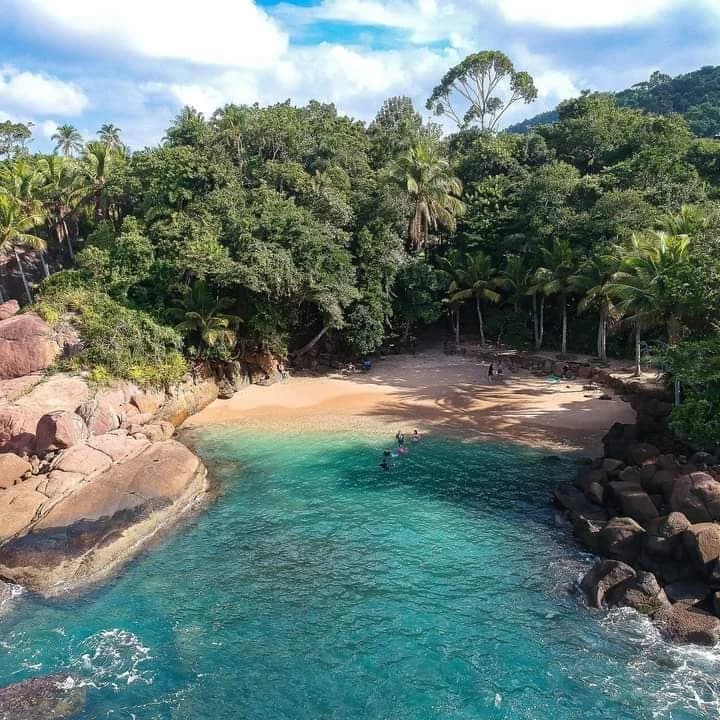
I pull myself over the final boulder and stop dead. Below me lies a sliver of coastline barely thirty meters long. Praia do Português is a crescent of pale sand guarded by towering, jungle-draped cliffs. The water here is an impossible, luminous turquoise, shifting and glowing under the morning sun. Local lore whispers that this secluded cove didn't even exist forty years ago—that a wealthy Portuguese man who owned the land above imploded the rocks to create his own private beach. Others say it is simply named after the family who built the secluded house on the bluff. Standing here, listening to the echoing crash of waves against the enclosed stone walls, the history matters less than the overwhelming, cinematic beauty of the present.
Leaving the rocky cove behind, I begin the long walk across the sweeping expanse of Praia do Félix. As I move from the sheltered right corner toward the center and the far left, the gentle lapping of the ocean transforms into a rhythmic, thunderous roar.
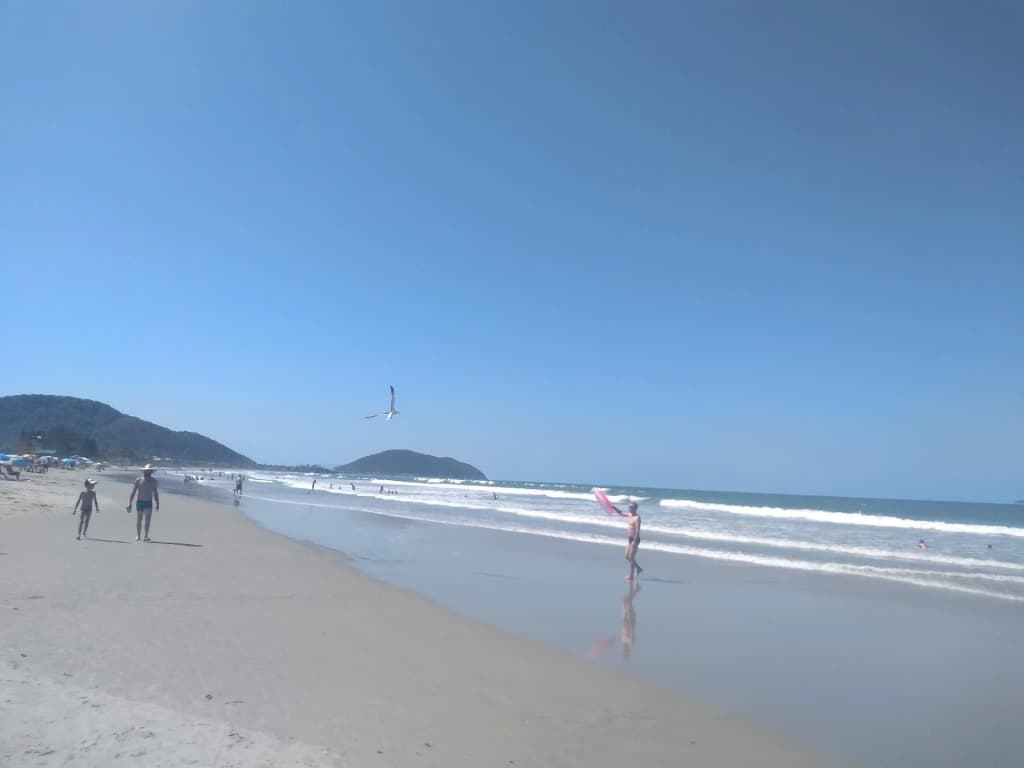
This is a beach of two distinct personalities. The middle and left sections belong to the wild Atlantic. The sea floor drops off sharply—a tombo beach, the locals call it—creating powerful, barreling waves that draw surfers from all over the state of São Paulo. The air here is charged, thick with sea mist and the sharp scent of ozone. I watch a surfer carve a graceful line down the face of a rising swell, the board slicing through the water with a crisp hiss. The crowds are thinner on this end, the vibe quieter, save for the roar of the ocean. The dense canopy of the Atlantic Forest still provides deep, cool shade, offering a perfect sanctuary for those who prefer the solitary contemplation of the crashing surf over the bustling family atmosphere of the shallow pools.
At the extreme left corner of Félix, the sand abruptly ends at a wall of dense, tangled jungle. This is the gateway to the third part of the Ubatuba trifecta: Praia das Conchas. The trailhead is unmarked, swallowed by green, and immediately steep.
The air inside the forest is thick, heavy, and intensely humid. I am instantly sweating. Thick roots snake across the muddy earth like dormant serpents, serving as natural, albeit slippery, stairs. I grip the rough bark of the surrounding trees for balance, instantly regretting my decision to wear flip-flops. The canopy above is a solid roof of emerald leaves, filtering the harsh sunlight into a soft, greenish twilight. It is a short trek—perhaps fifteen minutes of climbing and descending—but the dense humidity makes it feel like an expedition deep into the Atlantic Forest.
Then, the jungle breaks.
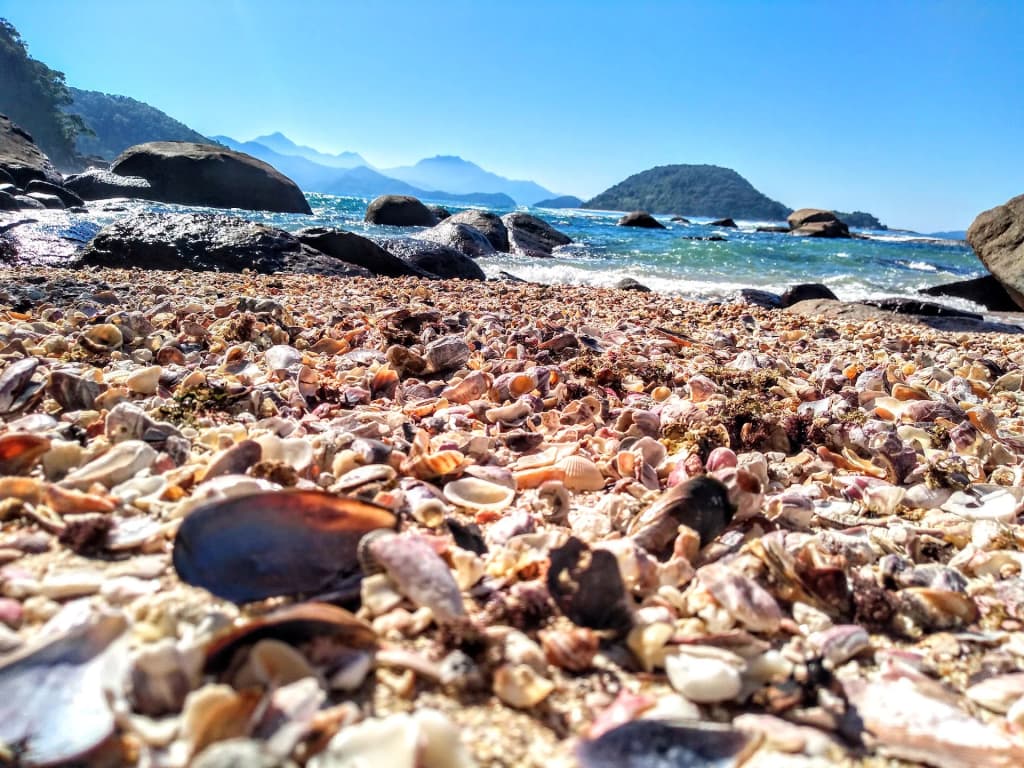
There is no sand here. When my feet hit the ground, it is to the sharp, musical crunch of millions of crushed shells. Praia das Conchas is tiny, a rugged notch carved into the coastline, framed by dark, imposing boulders. The ground is a mosaic of sun-bleached whites, pale pinks, and iridescent silvers. Walking barefoot is a tender, wincing exercise, but the raw, unpolished beauty of the place commands absolute attention.
I sit on a large, sun-warmed piece of driftwood and look out across the water. Just offshore, the lush, mountainous profile of Ilha do Prumirim rises from the sea like a sleeping green dragon. Boats from the right side of Félix occasionally buzz past, ferrying visitors to the island's waterfalls and shores, but here, on this little beach of broken shells, there is only the sound of the ocean rattling through the calcium fragments as it retreats.
I have wandered the powdery shores of the Philippines and watched the longtail boats cut through the emerald waters of Thailand, but sitting here with the humid breeze on my skin and the taste of sea salt on my lips, Ubatuba stands shoulder to shoulder with any of them. It is not just a beach; it is a living, breathing ecosystem of rocky coves, wild surf, and jungle-draped mountains. You don't just visit a place like this. You let it pull you in, tide by tide, until you become part of the landscape itself.
More Photos
More Adventures
 $50 - $120/day 3-7 days
 Conquer the Costa da Lagoa Trail in Florianópolis
Ditch the crowded beaches. Hike the Costa da Lagoa trail via Ratones in Florianópolis for wild jungle encounters, stunning views, and epic seafood.
 $50 - $150/day 3-5 days
 Chasing Tides and Tamarind: The Sensory Rhythm of Aracaju
Explore Aracaju through its disappearing sandbanks, rich seafood, and bustling municipal markets. Discover the soul of northeast Brazil in this journey.
 $50 - $150/day 3-5 days
 Ditch the Shoes: Conquering the Sand Roads of Jericoacoara
Skip the resort. Jericoacoara is a barefoot paradise of pristine lagoons, wild off-road trails, and towering dunes. Read the ultimate adventure guide.
 $15 - $35/day 1 days
 Rio de Janeiro 1-Day Budget Itinerary: The Perfect Route
Plan a flawless 1-day Rio de Janeiro trip on a budget. Get step-by-step instructions for Tijuca National Park, Dois Irmãos, and an Arpoador sunset.