
Tasting the Contrarian Soul of Geneva, Switzerland
Explore Geneva beyond the banks. Join a local for bison pastrami, lakeside filets de perches, and rich fondue in this immersive cultural travel guide.
"We are arriving at the Left Bank. My bank. Where I live," Paul says, adjusting the collar of his heavy wool coat against the brisk, sudden breeze coming off the water. The surface of Lake Geneva reflects the steely, bruised blue of the late afternoon sky, rippling gently against the stone promenade. "The people on the Left Bank are the better people."
I laugh, but he doesn't immediately smile back. It is that hyper-local, entirely serious rivalry that exists in every great city—the Bridge and Tunnel crowd, the Left versus Right Bank. Here, the wealth is palpable, a quiet, insulated hum beneath the clinking of porcelain espresso cups and the soft rustle of designer coats. You smell the crisp, almost violently clean air sweeping down from the Alps, mingling with the faint, earthy scent of roasted coffee from a nearby café.
"You wouldn't say that to a tourist, though," I offer, watching a flock of gulls circle a passing ferry.
"No," he admits, finally cracking a grin. "But my friends know. Welcome to the good side."
Getting to this so-called good side feels like a magic trick. We touch down at the airport, and the transition from runway to city center is entirely devoid of the usual travel friction. You step off the plane, follow the signs down a single escalator, and board a heavy, double-decker electric train that hums with a deep, satisfying vibration. Exactly five minutes later, you stand in Geneva Central Station.
The true genius of the city's infrastructure sits quietly in your pocket. If you sleep in a hotel here, the front desk hands you a small card upon arrival—a golden ticket granting unlimited access to all public transport in the canton. It is a law enshrined in local government, one that Paul casually mentions he helped enact years ago. You don't tap in or tap out. You simply walk onto the silent red trams that glide through the streets, trusting the system. The red tram glides past watchmakers and high-end boutiques, the windows framing a city that feels both ancient and hyper-modern. Nobody speaks loudly. The quiet is a form of respect, a shared agreement to maintain the peace of the public sphere. It is a beautiful honor code, though the looming threat of plainclothes ticket inspectors and the hefty fines of an incredibly expensive city keep everyone fiercely honest.
The local market smells of cured fat, sharp yellow mustard, and old, polished wood. We find ourselves staring at a small plate of dark, pepper-crusted meat that looks suspiciously like something you find in a New York deli.
The vendor wipes his hands on a pristine white apron. "People think Switzerland is just chocolate and cheese," he says, his English heavily accented with French. "But we are farmers. We are hunters. You want to try a little bit of Buffalo?" He holds out a paper-thin slice on the tip of a knife.
I take it, expecting a gimmick. It melts instantly on the tongue, tasting intensely of earth and smoke, with a sharp peppery bite on the finish. Bison, raised right here in the rolling hills surrounding Geneva. It is an incongruous thought—wild buffalo roaming the manicured Swiss countryside—but as Paul reminds me, this is an international city. They accept everyone, and every flavor.
We chase the bison with longeole, a dense, heavily spiced pork sausage steeped in local lore. It is a labor of love, prepared over several days, and we eat it in a warm, crowded restaurant where the clatter of heavy silverware bounces off the wood-paneled walls. It tastes like an elevated, deeply comforting bologna, rich and heavy, cut perfectly by a dab of sharp mustard.
To cleanse our palates, we walk down to the water. The temperature drops noticeably as we near the lake, the skin on my knuckles pulling tight in the cold. We take a table overlooking the water and order filets de perches, delicate white fish pulled directly from Lake Geneva.
A waiter in a crisp white shirt pours a local Chasselas wine into our glasses. It is crisp, mineral-heavy, and tastes faintly of the glacial runoff that feeds the region's vineyards. It cuts through the salt and the fat of the fish perfectly. The golden crust of the perch shatters softly between my teeth, yielding to sweet, tender meat inside. The salt lingers on my lips. The locals typically serve it with a mountain of thin french fries, but we opt for crispy, smashed potatoes that crackle loudly under the tines of my fork. It is the taste of a Geneva summer, even as the evening air bites at our faces. The lake stretches out beside us, an endless expanse of dark water reflecting the first flickering streetlights of the evening.
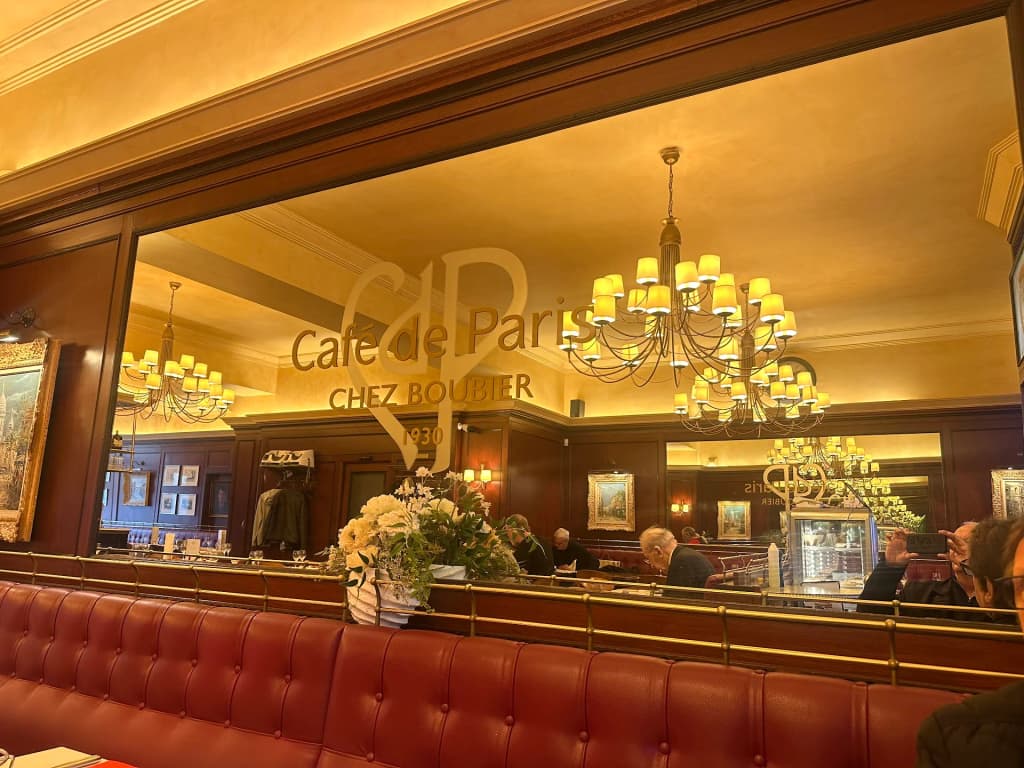
The true Swiss decadence begins when the sun goes down. We push through the heavy wooden doors of what Paul claims is the oldest bistro in Geneva. The smell is intoxicating—a thick, warm, almost physical blanket of melting Gruyère and dry white wine.
"This is how you do it," Paul says, sliding a golden, spherical object onto my plate.
It is a Malakoff, a dome of deep-fried cheese named after a battle where bruised Swiss mercenaries sought sustenance in hot oil and dairy. The exterior is a brittle, oily crunch that immediately yields to molten liquid cheese. It coats the throat, warm and impossibly rich. We follow it with a bubbling cauldron of traditional fondue. The heat from the fondue pot warms my face. Around us, groups of locals are engaged in animated, hushed conversations. There is no loud music, only the clatter of forks against ceramic and the low murmur of French. The ritual is simple and unforgiving: if you lose your bread in the pot, you pay for the wine. We eat until we are slow and heavy, finally scraping the charred, cheesy remains from the bottom of the ceramic pot. They call this crust la religieuse. It is, indeed, a religious experience.
The night isn't over. We step back into the cold and make our way to a brightly lit chocolatier. The air inside is thick with the aroma of roasted cocoa and toasted sugar. Paul casually hands over seventy-five US dollars for a small box of almond chocolates. I flinch at the price, but then I place one on my tongue. The chocolate is impossibly smooth, adhering to strict Swiss laws about real sugar and pure cocoa butter, and the almond is roasted to a perfect, echoing crunch.
But the real surprise comes in the form of Poubelles Genevoises—chocolates meticulously shaped to look like the city's old municipal trash cans.
"You're eating trash," Paul laughs, handing me a tiny chocolate bin filled with praline.
It is sweet, rich, high-quality trash. A joke from seventy years ago that became so beloved it evolved into a culinary institution.
We walk back out into the night, the cobblestones uneven beneath our boots. The city is quiet but deeply alive. You need Swiss Francs here, though a stray Euro works in a pinch if you don't mind the conversion rate. A simple fast-food burger costs over eight dollars; a casual beer costs ten. It is an expensive reality, a direct reflection of a high-income society where wealth is distributed generously among its residents.
But to dismiss Geneva as just a pricey layover for Rolex-wearing bankers is to miss its soul entirely. It is a city of distinct, beautiful contrasts. A place where international sophistication meets fiercely protected local traditions, where you eat fried cheese in a centuries-old tavern and delicate trash-can chocolates on the immaculate streets. I pull my coat tighter against the chill, listening to the gentle lap of the lake against the stone, realizing I could easily stay here just a little longer.
More Photos
More Adventures
 $50 - $150/day 3-5 days
 Abu Dhabi Travel Guide: Skip Dubai for the Real UAE
Think Abu Dhabi is just Dubai's sleepy sibling? Think again. Discover the real UAE with authentic street food, bustling fish markets, and raw culture.
 $100 - $250/day 3-5 days
 A Handheld Feast: Walking the Cobblestones of Edinburgh
Explore the sensory magic of Edinburgh. From handheld meat pies to cask-strength whisky, discover the warmth and history of Scotland's stunning capital.
 $150 - $500/day 3-5 days
 The Million-Euro Stage: Walking Paris's Champs-Élysées
Wander down the world's most famous avenue, where million-euro rents, strict aesthetic rules, and Parisian café culture create an intoxicating theater.
 $30 - $80/day 1-2 days
 Tasting Tokyo in São Paulo: A Walk Through Liberdade
Immerse yourself in the sights, sounds, and flavors of Liberdade, São Paulo's kinetic Asian neighborhood. Discover imported snacks, stationery, and culture.