
Boa Vista: Exploring the Amazon's Fan-Shaped Frontier City
Experience the unexpected beauty of Boa Vista, Roraima. Discover Macuxi indigenous crafts, the unique Lavrado biome, and sunset boat tours on the Rio Branco.
The woven buriti palm feels rough but pliable under my fingertips, carrying the faint, earthy scent of dried leaves and river mud. The air in the market is thick, heavy with the afternoon heat and the distant, rhythmic hum of Boa Vista's traffic. "It takes days to weave," Mr. Jaime says. He doesn't look up immediately, his calloused fingers moving with practiced grace to adjust the brim of the hat. He belongs to the Macuxi people, one of the indigenous ethnicities that form the cultural bedrock of Roraima.
"You made this entirely by hand?" I ask, turning the wide-brimmed hat over to trace the intricate geometric patterns woven into the crown.
He finally looks up, a quiet expression of pride wrinkling the corners of his dark eyes. "Only our hands and the palms from the forest," he replies, his voice barely rising above the whir of a nearby fan. I hand him twenty-five reais—a fiercely small price for a piece of living history—and place the hat on my head. It fits perfectly, casting a cool, immediate shadow over my face against the punishing equatorial sun. This humble artisan center, standing quietly near the Germanic-style architecture of the state's first church, serves as a quiet anchor of indigenous culture in Brazil's northernmost capital.

Leaving the shade of the market, the city of Boa Vista unfurls before me in a way I hadn't expected. I fall into step with Hélio, a local guide who leads me toward the Praça do Centro Cívico. The heat radiating from the pavement is intense, a dry, baking warmth that feels entirely distinct from the suffocatingly humid embrace of the deeper Amazon. It is a stark contrast to my arrival just a day earlier, when the bone-deep exhaustion of the long journey from Amapá was cured only by a surprisingly hearty, southern-style meal at Restaurante Tulipa and the crisp, air-conditioned sanctuary of the Ibis Hotel.
"Look at the streets," Hélio says, pausing to point down the wide, meticulously planned avenues that radiate outward. "The entire city was designed in the shape of a fan. Everything converges right here at the Civic Center."
It is a strikingly horizontal city. The sky here feels enormous, unbroken by towering skyscrapers or dense canopies. Hélio explains that the early pioneers who settled this region didn't have to hack through thick rainforest to build their homes. We are standing in the Lavrado, a unique biome similar to the Cerrado savanna. It is naturally flat, a sweeping expanse of low, scrubby vegetation that made it perfect for the cattle ranching of the first families. The city's very name, Boa Vista, was born from a simple observation by those early settlers: a local farm that boasted a truly good view of the sweeping river below.
By early afternoon, the sharp, mouth-watering scent of garlic, bruised cilantro, and frying fish pulls me toward Restaurante Rio. The wooden deck overlooks the water, offering exactly the kind of sweeping, unobstructed view that gave this city its name. The buffet is a mosaic of local ingredients, heavy with roots and river fish, but it is the Cumbuca Macuxi that commands my attention.
The dish arrives steaming hot in a dark clay bowl. I take a spoonful, and the complex, untamed flavors of the Amazon flood my palate. It is earthy, rich, and fiercely savory, with the tender, white flakes of local river fish melting instantly against my tongue. The culinary influence of the Macuxi people isn't just preserved behind glass in museums or relegated to artisan markets; it is alive, evolving, and thriving on the plates of the people who live here. I sit back, the wood of the chair warm against my shoulders, sipping a fiercely cold drink. I watch the water drift by, heavy and slow, its surface acting as a perfect mirror for the brilliant, cloudless blue of the sky.

The wooden hull of the small boat rocks gently, groaning in protest as I step aboard. Mr. Vou Pouco and his wife, Marina, greet me with warm, deeply weathered smiles that speak of decades spent on this water. The outboard engine sputters to life, a rhythmic, coughing thump that echoes across the wide expanse of the river. For just eight reais, locals take these little motorized canoes to cross over to the prainhas—the pristine, white-sand river beaches that emerge like ghosts during the dry season. It is there that families pitch umbrellas and swim in the cool, tea-colored water to escape the afternoon heat.
But we are going further. The boat slices through the current, a warm breeze whipping across my face as we head toward the distant bridge that connects this remote Brazilian state to neighboring Guyana. As we drift, the sky begins its evening performance. To the west, the sun dips toward the horizon, bleeding brilliant, saturated shades of crushed orange, violent violet, and bruised peach across the scattered clouds. I turn my head to the east, and there, rising quietly over the opposite bank, is the pale, heavy sphere of the moon. For a few suspended, magical minutes, the boat floats in the twilight between two celestial bodies. Mr. Vou Pouco cuts the engine to a low, rumbling hum. The only sound is the water lapping gently against the wooden hull. It is a moment of profound, echoing stillness, the kind that makes you forget the rest of the world exists.
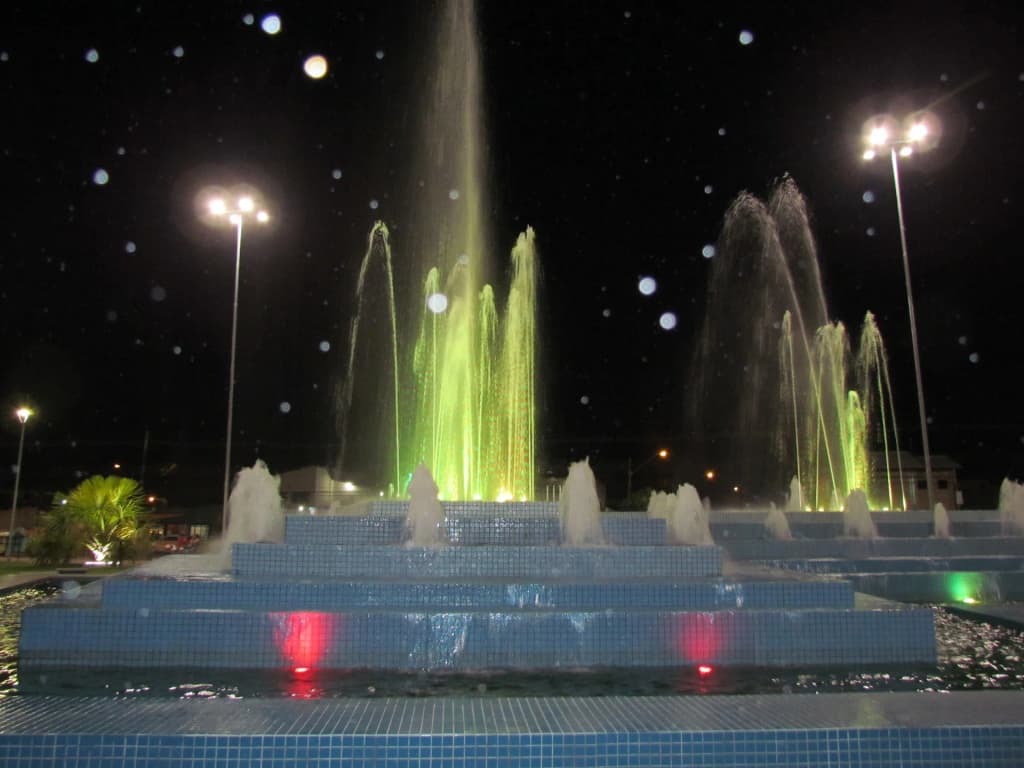
Night falls quickly here at the equator, and the city instantly changes its rhythm. I wander through the wide, paved walkways of Praça das Águas. The punishing heat of the day has finally broken, leaving behind a comfortable, breezy evening that draws families out of their homes. Suddenly, classical music swells from hidden speakers planted among the manicured gardens, and the massive fountains erupt into a choreographed dance. Columns of illuminated water shoot into the dark sky, glowing neon pink, electric blue, and emerald green. They rise and fall in perfect, sweeping time with the melody. Children shriek with laughter, darting dangerously close to the splashing water, their pure, unfiltered joy cutting through the warm night air.
My stomach rumbles, a quiet reminder that it is time for dinner. My final stop of the night is Recanto da Peixada, a local institution where the smell of roasting seafood hits you before you even walk through the door. Chef Hélio emerges from the swinging kitchen doors carrying a massive, steaming platter. It is a whole Dourado, one of the most prized, meaty fish of the Amazonian region, split open and smothered in a rich, creamy shrimp sauce. The scent is intoxicating—a heavy mix of melting butter, subtle ocean brine, and the unmistakable smoky char of a perfectly roasted catch.
I take my first bite. The tender, flaky fish and the sweet, plump shrimp mingle flawlessly, a heavy and satisfying end to a long day. As I sit there, listening to the clatter of plates and the hum of Portuguese conversation around me, I realize how deeply Boa Vista has surprised me. It is a place of quiet, unexpected intersections. The dry savanna meeting the edge of the rainforest. Deep-rooted indigenous tradition sitting comfortably alongside meticulously planned urban geometry. The fading heat of the sun balancing the cool rise of the moon. You do not just pass through a frontier city like this; you sit at its table, wear its woven palms, and let its slow, heavy rivers carry you somewhere entirely new.
More Photos

More Adventures
 $50 - $150/day 5-10 days
 Finding the Rhythm of Bahia: From Porto Seguro to Trancoso
Experience the sensory magic of Brazil's Costa do Descobrimento, from the chaotic nightlife of Porto Seguro to the barefoot luxury of Trancoso's beaches.
 $150 - $350/day 3-4 days
 Trancoso Travel Guide: 3-Day Itinerary & Budget Breakdown
Plan a practical 3-day trip to Trancoso, Brazil. Discover the best beaches, UTV tours to Praia do Espelho, and exact costs to optimize your travel budget.
 $50 - $120/day 3-5 days
 Chasing Echoes and Gold Dust in Tiradentes, Brazil
Experience Tiradentes, Brazil through a sensory journey of colonial architecture, deep-rooted history, and the rich culinary traditions of Minas Gerais.
 $50 - $150/day 1-2 days
 Conquer the Serra Verde Express: Brazil's Wildest Train
Ditch the tourist traps and ride the Serra Verde Express from Curitiba to Morretes. Discover ticket tips, seating secrets, and the best Barreado.