
Madrid and Barcelona in One Week: The Ultimate 7-Day Logistics Guide
A practical 7-day itinerary combining Madrid and Barcelona. Includes high-speed train logistics, metro card comparisons, and specific budget breakdowns.
Can you really tackle Spain's two largest cities in a single week? The short answer is yes, but only if you are ruthless with your logistics. Madrid offers imperial history and art, while Barcelona brings Mediterranean architecture and coastal energy.
Trying to do both without a plan usually results in burnout and missed train connections. I have structured this guide to maximize your 168 hours in Spain, focusing on the specific transport cards you need, the exact neighborhoods to book, and how to handle the transfer between cities efficiently.
Quick Facts
- Best Time to Visit: May-June or September-October (avoid August heat and closures).
- Currency: Euro (€). Most places take contactless cards.
- Power: Type C/F (Standard European 2-pin).
- Daily Budget: $150-$250 USD per person (mid-range hotel shared, meals, tickets).
- Visa/Entry: US/UK/CA citizens do not need a visa yet. ETIAS is delayed until mid-2025 or 2026.
Entry Requirements & Bureaucracy
Before you book a flight, you need to understand the entry rules. Spain is part of the Schengen Zone, and immigration officers can be strict about documentation.
The "Proof of Funds" Rule Immigration often requires proof that you can support yourself financially during your stay. The current standard is approximately €113-€120 per person, per day. You do not need this in cash; a credit card limit or bank statement on your phone usually suffices.
Travel Insurance It is mandatory to have travel insurance with a minimum coverage of €30,000 for medical expenses. Keep a digital or printed copy of your policy certificate handy at the border control.
Getting Around: The Metro Wars
Madrid and Barcelona have completely different transit systems. Do not assume your pass for one works in the other.
Madrid: The Tarjeta Multi
In Madrid, you must buy a red reloadable card called the Tarjeta Multi (€2.50).
- The Math: A single trip is ~€1.50, but a 10-trip pass (Metrobús) is €6.10. If you take 4 rides, the pass pays for itself.
- Sharing: Multiple people can use one card. You just tap it twice.
- Airport Fee: There is a €3 surcharge to enter or exit the airport stations (T1-T2-T3 or T4). You must pay this at the machine before leaving the station.
Barcelona: The T-mobilitat
Barcelona has transitioned to the T-mobilitat system (often a cardboard card with a chip for tourists).
- The Math: Single tickets are expensive (€2.40). Buy the T-casual (10 trips for ~€11.35) for the best value.
- Sharing: The T-casual is individual (cannot be shared on the same journey). If you are a couple, buy two cards.
- Airport Warning: The standard T-casual does NOT work on the L9 Sud metro line to the airport. You must buy a specific "Airport Ticket" (€5.15).
Pro Tip: In both cities, walking is often faster than the metro for short distances (under 1.5km). Use Google Maps or Citymapper to compare real-time options.
The Inter-City Transfer
To move between Madrid and Barcelona, forget flying. The high-speed train is faster city-center to city-center.
- Operators: Renfe (AVE), Iryo, and Ouigo.
- Time: 2.5 to 3 hours.
- Cost: €20 to €100+ depending on how early you book.
- Station Logistics: Trains leave from Madrid Puerta de Atocha and arrive at Barcelona Sants. Security checks happen before boarding, so arrive 30 minutes early.
The 7-Day Strategic Itinerary
This route starts in Madrid (more intense museums) and ends in Barcelona (coastal atmosphere).
Part 1: Madrid (Days 1-4)
Day 1: Arrival & The Egyptian Sunset
- Drop bags at your hotel (Recommend: Puerta del Sol or Malasaña areas).
- Walk to the Temple of Debod. This is an actual Egyptian temple gifted to Spain. Arrive 45 minutes before sunset for the best light.
Day 2: The Golden Triangle of Art
- Morning: Prado Museum. Book the 10:00 AM slot. Focus on Goya and Velázquez.
- Afternoon: Walk to El Retiro Park. It is massive (125 hectares). Visit the Crystal Palace (free entry).
- Evening: Tapas crawl near Calle Cava Baja.
Day 3: Royalty & Religion
- Morning: Royal Palace. It is one of the largest in Europe. The armory is worth the extra time.
- Mid-day: Mercado de San Miguel. It is touristy and pricey, but the visual spectacle is worth seeing. Grab a vermouth and a small tapa, then eat a full lunch elsewhere to save money.
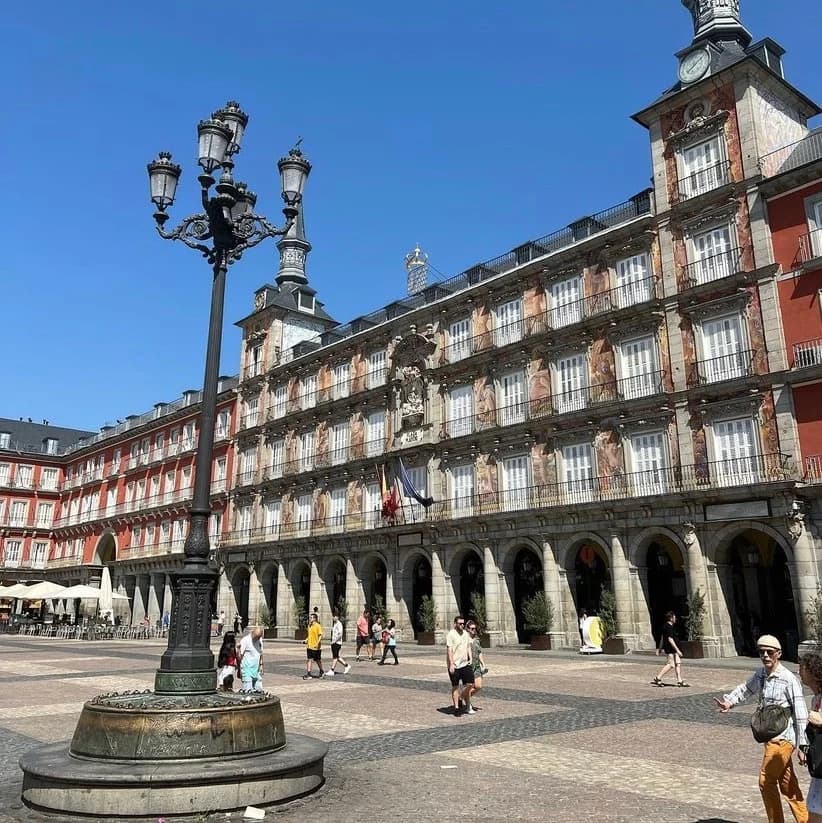
- Afternoon: Plaza Mayor and the historic center.
Day 4: Shopping & Departure Prep
- Walk Gran Vía for high-street shopping.
- Visit the Círculo de Bellas Artes rooftop (€5 entry) for the best skyline view of the metropolis.
Part 2: Barcelona (Days 5-7)
Day 5: The Transfer & The Ramblas
- Take the morning train to Barcelona.
- Check-in (Recommend: Eixample for safety/quiet or Gothic Quarter for atmosphere).
- Walk La Rambla from Plaza Catalunya to the Columbus statue. Keep your bag on your front here.
Day 6: The Gothic Core
- Morning: Explore the Gothic Quarter (Barri Gòtic). The narrow streets are a maze.
- Lunch: La Boqueria Market. Go to the back of the market for cheaper stalls.
- Afternoon: Ciutadella Park and the Arc de Triomf.
⚠️ Watch Out: If wind speeds exceed 70km/h, Barcelona closes its parks (including Park Güell) for safety. Check the forecast before heading out.
Day 7: The Gaudí Finale
- Morning: Sagrada Familia. This is non-negotiable: book tickets 3-4 weeks in advance. If you show up without a ticket, you will not get in.
- Afternoon: Park Güell or Casa Batlló. Both require advance reservations.
Budget Eats & Food Recommendations
Dining in Spain is a marathon, not a sprint. Lunch is 2:00 PM; dinner is 9:00 PM.
Madrid Picks:
- Chocolatería San Ginés: The classic stop for churros. Open 24/7. Expect a line. (~€5)
- Bocadillo de Calamares: Try La Campana near Plaza Mayor for a fried squid sandwich. Cheap and filling. (~€4)
- Pez Tortilla: Best tortilla de patata (omelet) in the city. Runny and rich.
Barcelona Picks:
- Vinitus: High-quality tapas. Get the Huevos Cabreados.
- Sartoria Panatieri: Award-winning pizza if you need a break from Spanish food. Reservations required.
- Xurreria Trebol: For a different style of churro (stuffed with cream or chocolate).
Safety & Common Mistakes to Avoid
Spain is physically safe, but petty theft is an industry here.
1. The Table Phone Rule Never leave your phone on the table while eating, even if you are sitting outside. It takes seconds for a "map seller" to distract you and swipe it.
2. The Metro Backpack When on the metro, wear your backpack on your front. Do not stand near the doors with your phone in your hand just before the doors close—snatch-and-runs are common there.
3. The Sangria Trap Locals rarely drink Sangria with dinner; they drink Tinto de Verano (red wine with lemon soda). It is cheaper, more authentic, and usually tastes better.
With the right metro cards in your pocket and your museum tickets booked weeks ago, this dual-city trip is entirely manageable. Enjoy the contrast between the Castilian plateau and the Catalan coast.
More Photos
More Adventures
 $50 - $150/day 3-5 days
 Tango, Steak, and Rivalries: A Buenos Aires Story
Experience the soul of Buenos Aires. From the colorful streets of Caminito to the modern elegance of Puerto Madero, discover where to eat, walk, and explore.
 $80 - $250/day 4-7 days
 The Quiet Art of Experiencing Paris on a Budget
Discover how to experience the romance of Paris without breaking the bank, from secret bakery rituals to navigating the city's economic rhythms.
 $120 - $350/day 2-3 days
 Disneyland Paris Strategy: Ride Hacks & Coaster Secrets
Think you know Disney? Think again. Discover the underground secrets, massive coasters, and insider hacks to conquer Disneyland Paris like a pro.
 $50 - $120/day 3-5 days
 Chasing Echoes and Gold Dust in Tiradentes, Brazil
Experience Tiradentes, Brazil through a sensory journey of colonial architecture, deep-rooted history, and the rich culinary traditions of Minas Gerais.