
Zermatt, Switzerland: Matterhorn Views and Alpine Silence
Experience the sensory contrasts of Zermatt, Switzerland. Wander 15th-century Hinterdorf chalets, ride the Gornergrat Railway, and face the Matterhorn.
The heavy wooden doors of the Cervo Mountain Resort close behind me, instantly silencing the crunch of fresh snow under my boots. It is half-past five, the alpine sky already bruised purple, and the air smells intensely of burning pine, melting frost, and damp wool. A young man behind the reception desk looks up, his smile warm against the ambient chill of the mountains.
"Tea to warm up?" he asks, gesturing toward a steaming silver samovar. "Or perhaps a glass of Prosecco?"
I choose the bubbles, letting the cold, crisp wine mirror the temperature outside. The lodge is a brilliant contradiction—a cluster of modern alpine buildings standing right at the finish line of a ski slope. Outside, the heated outdoor pool sends thick plumes of steam into the freezing twilight. I run my hand along the rough-hewn wooden walls of the lobby, feeling the radiating heat beneath the floorboards. We hadn't planned an itinerary for tonight. It is simply a moment to exist, to let the altitude settle into our blood, and to wander down the public elevator that connects our quiet mountain refuge directly to the pulsing heart of the village below.
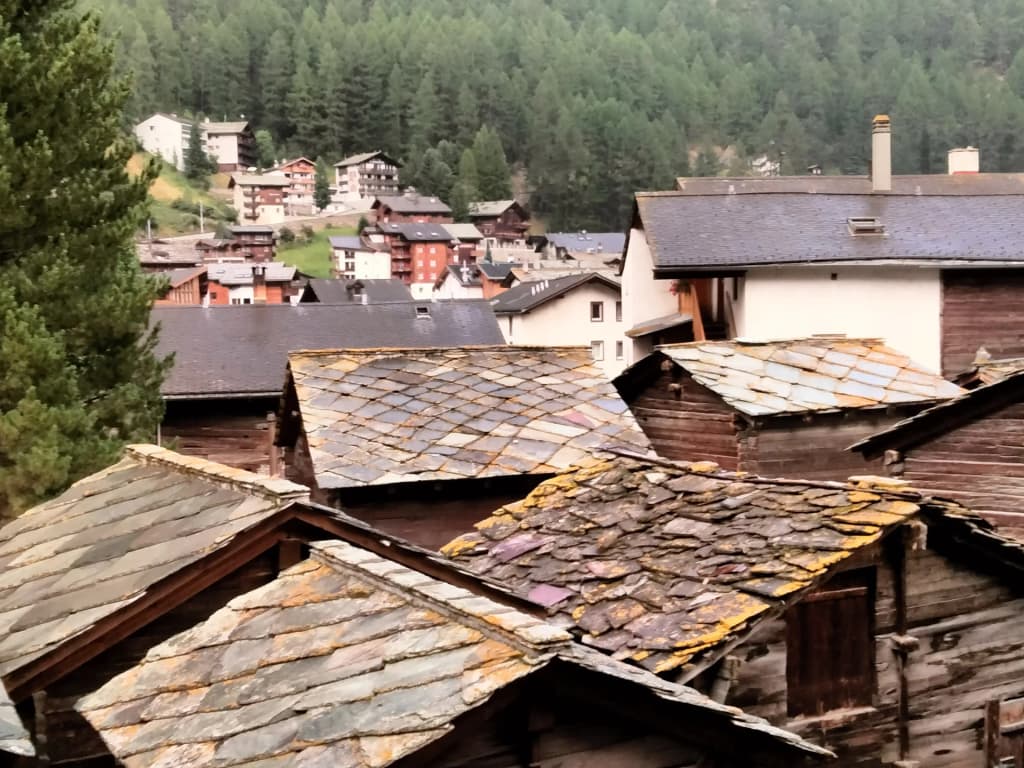
The air in the Hinterdorf—Zermatt's oldest quarter—bites at my cheeks. The scent of woodsmoke is thicker here, clinging to the labyrinth of dark, sun-scorched chalets that date back to the fifteenth century. Walking these narrow alleys feels like stepping onto a medieval film set. The structures are impossibly small, leaning against each other like exhausted hikers.
"You're looking at the stones," a voice says.
I turn to see an older man in a thick woolen sweater pausing on the icy path. He nods toward the large, flat, circular stones wedged between the wooden stilts and the base of the cabins.
"To keep the foundations level?" I guess, my breath pluming white in the darkness.
He laughs, a dry, raspy sound that echoes off the timber. "Mice. The rodents couldn't climb past the stone overhang. Up top was where they lived, and below was where they kept the grain. You didn't share your winter food five hundred years ago."
He points a gloved finger toward a small memorial plaque nearby, dedicated to a local legend. "He was a guide here," the man tells me, his voice dropping to a reverent murmur. "Climbed the Matterhorn more than three hundred times. The last time, he was ninety years old. That's the blood of this valley."
The morning breaks blindingly bright, the snow reflecting the sun like shattered glass. The standard seventy-four Swiss Franc day pass usually demands a long, shivering wait at the ticket office, but the Ikon pass in my jacket pocket—a yearly commitment to global mountains—lets us bypass the morning crowds entirely. We walk straight to the turnstiles. Within minutes, we are swallowed by the dark tunnel of the funicular, rocketing upward through solid rock.
When the doors slide open at the Sunnegga station, 2,288 meters above sea level, the light is staggering. We step out, and there it is. The Matterhorn.
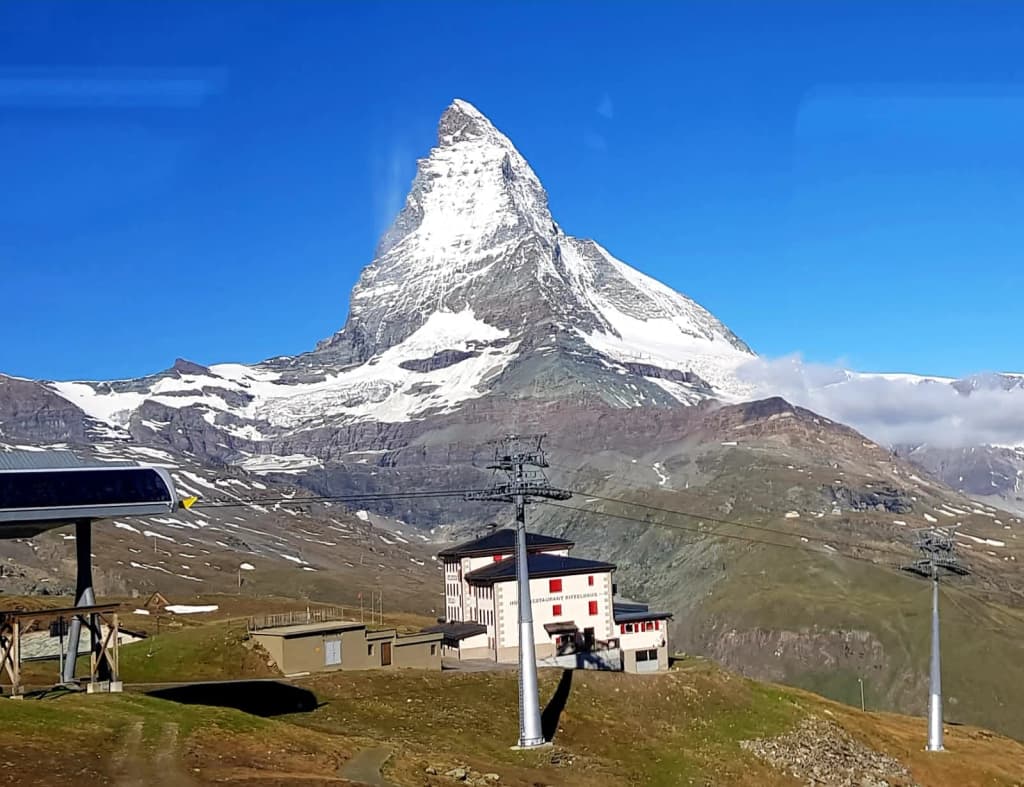
It doesn't look like a mountain; it looks like a geological exclamation point. It dominates the skyline, a jagged tooth of rock and ice splitting the border between Switzerland and Italy. Down below, beginners carve clumsy lines through Wolli Park, their laughter carrying on the thin, sharp wind. We aren't here to ski today, but rather to chase the sheer verticality of the Alps. We order hot chocolates on the sun-drenched terrace of the station restaurant, wrapping our freezing fingers around the ceramic mugs, tasting the rich, dark cocoa as we stare at the impossible peak.
The gondola hums a low, metallic vibration as we ascend higher into the clouds. We are bound for the Matterhorn Glacier Paradise, the highest cable car station in Europe. A sign at the bottom gently warned that children under three shouldn't make this journey due to the extreme altitude. As we breach 3,883 meters, I understand why.
The air up here is desperately thin. My lungs pull harder with every step, and a dull, pulsing ache settles behind my temples. It feels a bit like running up a flight of stairs while breathing through a straw. But the discomfort evaporates when I look out. We are standing above forty alpine glaciers. On a clear day, you can see the rounded dome of Mont Blanc in France.
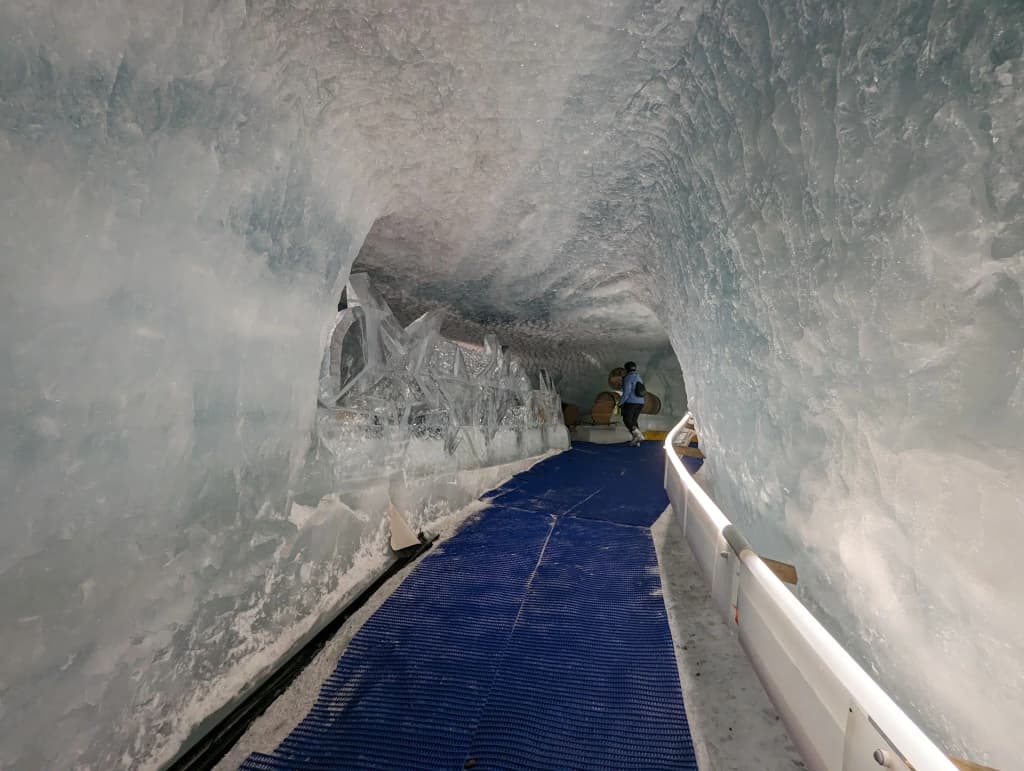
We descend into the Glacier Palace, a tunnel carved directly into the eternal ice. The temperature drops sharply, a deep, penetrating cold that seeps through the soles of my boots.
"Now I know how the frozen nuggets in our freezer feel," my partner jokes, their voice muffled by a thick scarf.
The ice walls are smooth and blue, glowing with an otherworldly luminescence. It is profoundly quiet inside the glacier, an ancient silence that has lasted for millennia. Emerging back into the blinding daylight, we seek refuge in the summit restaurant. We tear open chemical hand warmers, shoving them into our pockets, and devour a plate of heavily salted fries paired with a glass of red wine. The combination of hot grease, rich tannins, and freezing air is an intoxicating sensory overload.
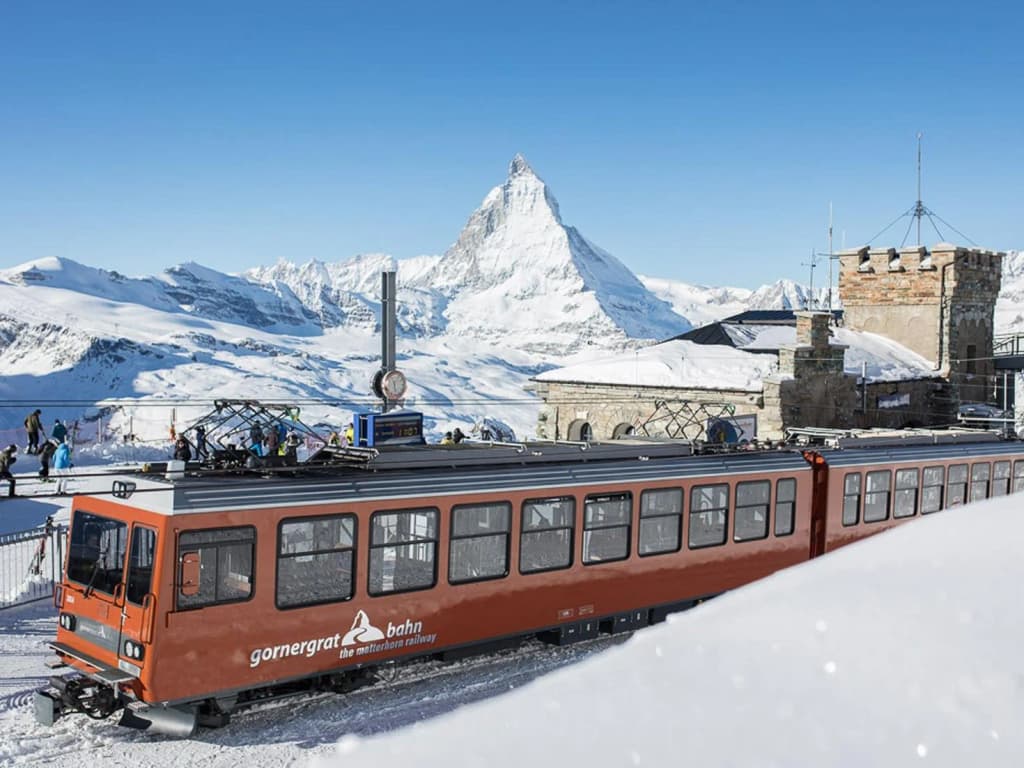
If the cable car is an exercise in suspended vertigo, the Gornergrat Railway is a masterclass in slow, deliberate engineering. The bright red cog train clatters up the mountainside, a mechanical heartbeat against the silence of the snow. It departs every twenty-five minutes, steadily grinding its way to 3,089 meters.
At the summit, the Kulm Hotel—the highest hotel in Europe—stands like a solitary fortress, complete with silver astronomical observatory domes catching the afternoon sun. I lean against the viewing railing, the metal freezing against my bare forearms. A playful sign points outward: Rio de Janeiro, 9,220 kilometers.
Looking at the jagged, chaotic peaks spreading out in a 360-degree panorama, I think about the violence that created this silence. Millions of years ago, the African and European tectonic plates collided right here, buckling the earth's crust and thrusting this ancient rock into the sky. Half of the mountain I am staring at is technically African; the other half is European.
I pull my collar up against a sudden gust of wind. The Alps do not care about borders or time. They simply exist, vast and indifferent, waiting for the snow to fall again.
More Photos
More Adventures
 $60 - $150/day 3-5 days
 Get Lost in Bento Gonçalves: The Real Brazilian Wine Country
Skip the beaches. Rent a car and dive into Brazil's Italian wine country. Discover century-old mills, wild boar salami, and epic vineyards in Bento Gonçalves.
 $80 - $200/day 5-7 days
 Conquer Cusco: The Ultimate High-Altitude Adventure
Push your limits in Cusco. From the dizzying heights of Machu Picchu to the brutal treks of the Sacred Valley, here is how you conquer the Andes.
 $150 - $300/day 3-5 days
 Shattered Ice and Woodsmoke: An Immersive Journey Through El Calafate
Step onto the ancient, groaning ice of the Perito Moreno glacier and into the warm, woodsmoke-filled parrilladas of El Calafate in this sensory Patagonian journey.
 $45 - $125/day 3-4 days
 4 Days in Salvador: A Practical Itinerary & Budget Guide
Plan your trip to Salvador, Brazil with this strategic 4-day itinerary. Discover exact costs, Uber logistics, safety tips, and street food recommendations.